Immediacy Redivivus:
Michael David’s Paintings
by Donald Kuspit
The best abstract
painting seems “nothing short of miraculous,” the French poet and
critic Yves Bonnefoy remarks, for it satisfies “the desire for the
immediate”(1)--for pure sensation, uncorrupted by consciousness of
meaning. Bonnefoy thinks that the experience of immediacy--of pure
presence, directly given, with no need for language to shape it into
comprehension (and mute its impact)--is an illusion. It is a private
myth--magical thinking--that has been given social credibility,
ironically by the need to escape social pressure. The “conventional
readings of the world” are not so much defeated as complicated by
the mirage of immediacy, he argues. They need a codicil explaining
why the belief in immediacy must be abandoned, however reluctantly.
Bonnefoy doesn’t want to wait for the feeling of immediacy to fade
away, as it will inevitably do because it is inherently transient,
but discredits it as a subjective indulgence. Looking at it from the
disillusioning point of view of everyday reality, he implies that we
must distrust the spontaneity with which it appears, thus
undermining it before we can savor it, and reap its emotional
benefits. He has no interest in the way it enriches the feeling for
life, reminding us that there is life beyond everyday life. Bonnefoy
never imagines that the experience of immediacy cannot be
conventionalized--that it is not meant to be “read,” and in fact
cannot be read in worldly terms. He seems to think that we should
have intellectual guilt every time we experience an abstract
painting as sheer immediacy--eternally present, as it were, and as
such suspended beyond time. We should “qualify” this “mystical”
experience--peculiarly “metaphysical” for all its physicality--by
analyzing it away, that is, use our minds to purge it as a lie and
hallucination.
Michael David’s abstract paintings renew immediacy, indeed,
reconstitute, strengthen, and even apotheosize it. They raise it to
a feverishly fresh intensity with their remarkable touch, indicating
they are among the very best painterly abstractions made. To me they
make it transparently clear that immediacy may be an illusion to the
intellect but it is not one for the senses--for touch and sight,
mingled together inextricably in ecstatic perception. For them,
painterly immediacy is ultimate reality: pure sensuous intensity
transcendent of ordinary, habitual understanding of the world, which
is mediated by socially sanctioned language and banal meanings that
force sense experience into their procrustean bed.
David may be the most innovative master of immediate surface since
the Abstract Expressionists. He has acknowledged his debt to
Abstract Expressionism, but he has transformed it. Where the
Abstract Expressionist paintings of the forties and fifties seem
like modern cave paintings, as their crude, unfocused, often
meandering, turbulent painterliness suggests, and as such to
reinstate prehistory, David seems to turn the cave into a temple, as
his more considered, concentrated, indeed, dense, contemplative
painterliness indicates, so that his paintings have the aura of post
history. The sublime is gained with no loss of force--no sacrifice
of painterly dynamics. Indeed, there is a gain in the sense of
bodiliness: each of his works has a certain “body”--density of
presence--so that it seems to embody the sublime, not simply evoke
it. His paintings make the abstract sublime vividly concrete, as
though it could be grasped rather than existed as some numinous
beyond.
The challenge of gestural abstract painting is to break through the
barrier of reflection--we put it up to keep ourselves at a certain
mental distance from the world, so that our immediate impressions of
it do not overwhelm us, and to sort them out and organize them into
coherent and practical patterns--by developing a dramatic immediacy
of surface. When the breakthrough occurs, as in David’s
abstractions, it restores the lability of sensuous appetite natural
to the human body, but that the human mind has repressed for the
sake of worldly functioning. David’s powerful, deeply felt, boldly
visceral gesturalism embodies this appetite in the act of arousing
it: his painterly immediacy has prereflective sensuous appeal, which
is why it seems preternaturally fresh--uniquely vital, however at
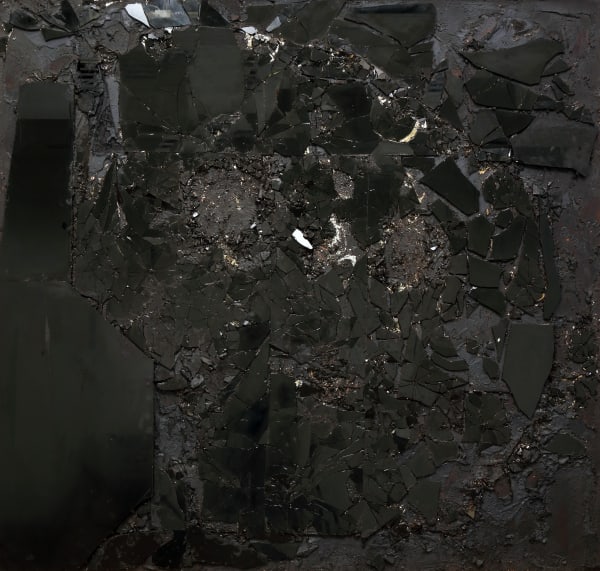
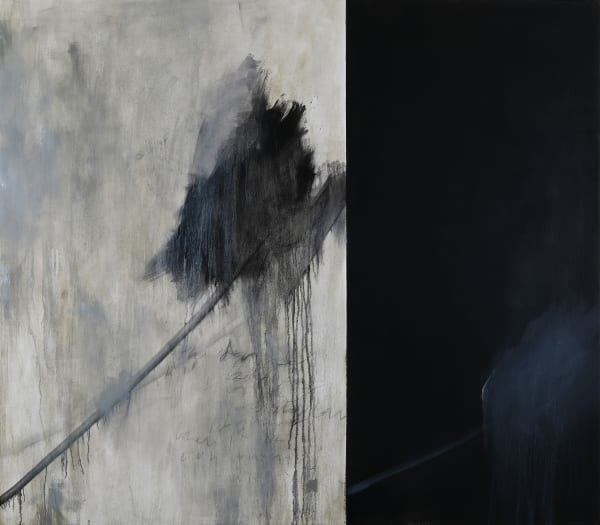
times, morbid. The blackness of Refuge (all works 2000) certainly
seems morbid, however many traces of bright color--mostly orange,
but also bits of red and yellow, as though the orange was
disintegrating into its components--erratically break through the
dark surface, which seems generally disintegrated. David tells me
that he sometimes uses as many as ten “rounds” of paint--the word is
telling, suggesting that for him painting is a kind of boxing, that
is, in Harold Rosenberg’s famous words, the canvas has become an
arena of self-confrontation, indicating the amount of combative
energy he puts into it--to build up his surface. For all its
solidity, it has a fragile, fragmented look, in part because of the
beading of the wax emulsion with which he paints. But, if Rosenberg
is right, it also tells us something about David’s sense of self.
Building up that looks like tearing down--construction that looks
like destruction --is in fact the emotional as well as physical
substance of David’s painting. Plane of canvas is placed upon plane
of canvas, creating a three-tiered pyramidal architecture that has a
family resemblance to an Aztec temple--but an abandoned and ruined
one, as its stripped and above all blackened appearance suggests.
Nonetheless--and this is the essential paradox of David’s
paintings--this fundamental, melancholy structure is kept alive by
the immediacy and vigor of the paint that at the same time signals
the decay and death which mark it. The tension between the physical
immediacy of the paint and its geometrical underpinning--between
gesture and structure, interpenetrating, so that structure seems
less fixed, as though in insecure process, and texture more fixed,
as though absolutized in amber--keeps the work dialectically alive.
And embedded in this immediacy, like an ironical beacon, is a black
cross, its arms lengthened until they blur into the painterly
ground. It arises like an epiphany from the mire of agitated
blackness--a dark epiphany, as it were, confirming the darkness of
the paint. The projection of the geometry--the painting is a relief,
even as the relief is a pure painting--thrusts the flat cross
forward, so that it confronts us, but it remains an abstract
vision--our ambiguous vision.
David’s painting is a kind of negative icon, composed of crushed
gestures. I cannot help thinking of George Steiner’s remark that
“our aesthetic forms explore the void, the blank freedom which come
of the retraction (Deus absconditus) of the messianic and
divine.”(2) He argues that where art, in its “kinship...with the
calling on mystery in the matter of the world and of man”--the
mystery in matter itself, one might add--once “enact[ed] the
epiphany of a real presence,” it now reveals the “encounter with a
‘real absence’.” Steiner thinks that this is what we see in Malevich
and Ad Reinhardt. We must add David to the list of these great
abstractionists, for he has shown us that real [material] presence
can also be real [spiritual] absence. Immediacy can be made to serve
the purposes of absence and loss as well as presence and givenness.
Because David’s paintings convey both simultaneously, we are forced
to ask whether he means to suggest that there are hidden sparks of
life (vital colors) in the ashes of the dead symbol or whether he is
flatly stating--as the blunt, recessed flatness with which the cross
is given suggests--that it is irremediably dead. Is the cross a
phoenix or Lazarus in the process of rising from the grave (it is
“engraved” in the flatness, as though in a grave, perhaps an empty
one), or it is a ghost that however haunting confirms the triumph of
death? Is David struggling to restore the traditional symbol of
salvation or is he showing the permanent ruin that it has
become--confirming that it is also a symbol of suffering unto death?
Does his cross still have the miraculous power to absolve us of our
sins or is it a black mirage that mocks us, deepening our guilt?
Does it symbolize the depth of suffering--a new emotional dark
age--or is it a consoling omen of resurrection--a promise of purity,
a blessing in disguise? Is it a shadow with no substance, or is its
substance hidden in the painterly shadows? Refuge, clearly, is an
ironical title. Part of the greatness of David’s painting is that it
can raise these existential questions--that it can suggest our
fundamental uncertainty about ourselves, indeed, our ambivalence
about being. David’s black cross--his whole painting--is emotionally
profound as well as brilliantly conceived. In general, his paintings
are emotionally eschatological, that is, they articulate inescapable
emotional concerns. But everything is not tragic
bleakness--demiurgic blackness--in David’s oeuvre. Mourning and
melancholy are overcome: gnostic illumination occurs in the subtle,
progressive transition (as I see it) from Population (Dark Blues)
through Population (Orange) to Population (Blue). Darkness is
transformed to light by its passage through color, which recedes
into seductive mist. Restoration, with its open white surface
through which strong, passionate color appears, and Brooke, with a
white surface that veils darkness--it is overcome, however much it
threatens to break through--confirm the momentum of the process,
which began with the almost completely closed black surface of
Refuge. Finally there is the marvel of 777, with its pure white
luminosity, completing the process of transfiguration--confirming
salvation, liberation from the fatalistic black, the dark, the
defeated. Death has lost its sting, and been replaced by eternal
light. The tension between light and dark has been resolved--the
victory belongs to the forces of light. (With the exception of
Population (Dark Blues) and Population (Orange), which are flat
field paintings, all these works have the same pyramidal structure
and painterly density as Refuge.)
Yet the tension generated by the breakthrough of underpainting--the
friction between surface and surface-within-surface--remains,
however subliminally, as the bits of unanointed structure that
appear near the bottom of 777 and the subliminal, impacted darkness
of Brooke suggest. Simply on the level of color relationships
David’s paintings are astonishing feats of subtlety--a delicate
blending of incommensurate colors, making the spectrum freshly
sensuous, all the more so because of the gestural state of the
colors. Sensation has become transcendence in these works, physical
density confirms spiritual purity. At the same time, there is an
indwelling disturbance, signalled by the rupture in the surface,
through which the depth is glimpsed. Painterly magma erupts through
this fissure, almost covering it over: surface and depth reconcile
in the fluidity, healing their difference while acknowledging it.
Whether my gnostic interpretation is right or wrong--whether these
works are masterpieces of sacred paintings, as I think--they are all
aesthetic masterpieces. They restore immediacy to credibility after
it has become a decadent convention. What began to be worked by
Kandinsky and seemed overworked in Pollock, and finally exhausted by
expressionistic overuse, has been given not only a new lease on life
by David, but extended into new technical as well as emotional
territory. Flatness is “architected,” as it were, so that it becomes
a platform for the painterliness that finesses it, even as that
painterliness is made more “forward” by it. David has regenerated
painterliness without making it seem precious, even as he refined it
so that it is no longer raw, primitive, headlong, naively
aggressive. The primordial effect of immediacy remains, even as
gesture seems deliberate as well as spontaneous. Indeed, the effect
of immediacy--the epiphany that is immediacy--is all the stronger,
when it occurs, because of the contradiction. For the tension
between spontaneity and deliberateness--instinctive power and
reflective control--makes the breakthrough into immediacy, the
demonstration of the immanence of immediacy, all the more moving and
convincing. It becomes a breakthrough into integrity, rather than a
pro forma exercise in painterly skill.
Thus, David’s paintings concentrate in themselves the history of
modernist painting without selling its emotional possibilities
short, as happened when it deadended in post-painterly abstraction.
All one has to do is look at his works on paper, with their
evocative modulations of tone and surface--their perfection of
subtlety --to realize the truth of this. They are masterpieces of
unresolved tension--presence and absence compete in them, even as
they seem to converge--showing how intimate abstraction can be.
Clearly painting will never die, if David has anything to say about
it.
NOTES
(1)Yves Bonnefoy, “On Painting and Poetry, On Anxiety and Peace,”
The Lure and the Truth of Painting (Chicago and London: University
of Chicago Press, 1995), p. 171
(2)George Steiner, Real Presences (Chicago and London: University of
Chicago Press, 1991), p. 229
“A Desperate and Honest
Search”:
Some Notes on New Works by Michael David
by Jerry Cullum
Michael David’s
photographs engage in a difficult dialogue with both religion and
art history. He doesn’t challenge belief in either case; he
challenges practice, and he asks hard questions.
David’s engagement with issues of our bodies springs from the
rebellion of his own body in the form of debilitating illness
brought on by the tools of encaustic painting. Scarcely the first
man to be laid low by the materials of his trade, he used the
experience to address and identify with moments in great art.
Specifically, Manet’s Dead Toreador struck him as a model from which
he could wrest a new, very personal meaning.
He went on to produce a species of self-representation based on deep
emotional identification. Eventually the dialogue with physical
suffering led to a confrontation with other emotional issues, by way
of other great moments in painting. David doesn’t so much study a
painting as enter into its unarticulated and almost certainly not
consciously intended messages.
Through several intermediate steps, this led to his greatly
abstracted, monumental photographs. He literally strips down key
moments in Mantegna, Manet, and Caravaggio. Maintaining their drama
but not more than the essence of their figures’ postures and
symbols, he manipulates their imagery for his own ends.
Those ends involve, he says, arousing compassion, in himself and in
his viewers. He sets out to confront topics of homophobia, racism,
and gender expectations (the role of women) through the
transformation of some of our best-known visual expressions of
religious or sexual suffering or ecstasy.
Suffering and ecstasy are precisely the polar opposites that David
blends in his photography as much as the master painters did in
their works on canvas. Cupid and Gabriel bring very different
pronouncements of the meaning of love and the generation of life;
but both bring challenges to the way life was lived before the
moment of the angelic proclamation or the arrival of the erotic
god’s little arrows. By the time David is through with their
stories, the figures in his photographs are no longer retellings of
Roman mythology or of the Christian story of the incarnation of the
redeeming divinity, announced through the words of an angel. They’re
possibilities of being, housed in our own contemporary imaginations.
Getting to this point of psychological intensity isn’t a simple or
single-track road. David plays with several possibilities for each
posture, replacing a white Christ or Cupid or Narcissus or Archangel
Gabriel or dead or dreaming toreador with a naked black male, or a
distinctly muscular white female. Occasionally he relieves the
tension that all this generates with a comic gesture, such as the
twin angels giving the viewer their raised middle fingers. More
often he keeps up the emotional pressure, reducing situations to a
single dramatic encounter or solo performance against a backdrop of
pure black that recalls the charged darknesses of El Greco or Goya,
although David cites Bronzino and Caravaggio as his points of
comparison.
He doesn’t necessarily reproduce meaning altogether literally, but
finds those moments of discomfiting imagery that are better
represented by titles that come from other paintings. Most notable
in this regard are his crucifixions, in which his replacements for
Christ wear the wrist bindings in lieu of nails that some painters
reserved for the thieves crucified on either side of the central
figure. These works are called “Taking of the Christ,” a title which
Caravaggio uses for a memorable scene of the betrayal of Jesus by
Judas in the Garden of Gethsemane. The melding of the two moments of
the Passion allows for multiple meanings. His nude black man or
white woman “take” the Christ in the sense of taking on the posture
and possibly the sense of betrayal and self-sacrifice involved in
the Crucifixion. (Deep re-imagining of and identification with the
sufferings of Jesus have, of course, long been part of Catholic
practice, so this reading isn’t altogether without precedent.)
Whether they also declare their creatureliness by wearing the image
of a crucified thief depends on which paintings the viewer is
thinking of.
It would be a stretch to claim that all this psychology and
Christian theology is in David’s mind when he composes these
photographs, but the point is that they allow the viewer to create
an independent dialogue with the art historical models from which
they come. We can take what we will from his Narcissus or his
Magdalene in ecstasy or his isolated scrap of the seven acts of
mercy. They ask only that we enter into the dialogue.
As with any works of art, that dialogue is deepened by the degree of
visual literacy the viewer brings to the photographs. The copying of
the sinuous geometry of Brancusi’s bird sculpture by David’s nude
model results in a striking image. The title Brancato’s Brancusi
reminds us of something we might have missed in our admiration of
the photograph’s formal purity. If for some reason the viewer were
ignorant of Brancusi’s modernist achievement in sculpture, this
would still be a stunning picture.
The same goes for all of David’s photographs. It is possible to
imagine a world in which someone would come to these works wholly
innocent of the tales of Mary Magdalene’s replacement of sexual
ecstasy with contemplation of the inner force of divinity, or
Narcissus’ fatal fascination with his own image. (Think of someone
raised in the Buddhist culture represented by the statues of the
enlightened Gautama that David has also transformed in this body of
work. It is possible, likewise, to imagine a viewer who knows the
story of annunciation, life, and redemptive suffering of Jesus
Christ, but not the story of suffering and redemption from suffering
that is the life of Gautama Buddha.)
What would an only partially informed viewer get from these
photographs? A great deal. However, it not only helps, it is almost
essential to know the original stories in order to understand the
meaning of Cupid’s arrows or Gabriel’s clustered bunch of lilies. It
is probably not necessary to know the original story to understand
the emotional force of David’s wrapped or repeated Buddhas, but it
deepens our reaction to think of the Buddhist meanings of veils of
ignorance or revelations of the hidden inner light.
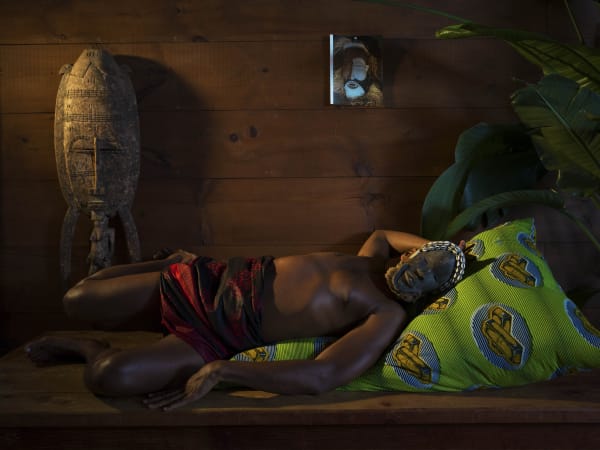
David’s dead toreadors, his original inspiration and his only major
departure from the realms of religion and mythology, run a
surprising gamut. Again, the trappings of the costume are minimal
but essential for the metaphor; without them, it might be difficult
in some cases to know whether we are seeing, for example, Manet’s
dead toreador or some variation on Holbein’s dead Christ. As it is,
we know; and what we know is that David has confronted us with all
the possibilities, from graphically visible male genitalia to death
in the bullring devolved to an erotic dream. The horror and
helplessness of death mingled with the attraction felt by, for
example, Keats (“I have been half in love with easeful death”)
collide in these images. This isn’t a figure laid low by the
violence of the bull’s horns; it’s a figure in the posture of
collapse and/or sleep. It allows (or more accurately, they allow) us
to project a much wider range of reactions on the image.
In this case, David has archetypalized a historical moment as much
as Manet did, transforming into lasting transcendence an event that
would otherwise be ultimately of limited significance. Great art and
great literature have explored in depth the universality and the
specificity of death. We view it as individual tragedy and we find
it alarmingly alluring, and all of our reactions have been embodied
in works of art. As with the crucified black man and white woman (we
can fill in all the other possibilities), the power and beauty of an
image allow us to contemplate in tranquility topics with which we
may otherwise wrestle in our most anxious midnights.
David does all this with just a few formal tools. He wrests maximum
impact out of the musculature of the human body; his original
sources were baroquely contorted, to be sure, but he arranges his
models’ postures to bring out the maximum impact of well-defined
abdominal muscles or gluteal lineages. His lighting would be accused
of excessive theatricality were he not merely replicating the
already existing theatricality of the paintings from which he
starts.
Eliminating the clutter of symbols that surround the figures
originally, however, turns these photographs into distinct dialogues
with modernist simplifications of form. Brancusi enters into the
dialogue quite appropriately, as a reminder that once the great
images of myth and religious discourse are extracted from their
original context, they can be seen as independent elements of art.
We lose parts of the story to gain clarity, just as modernist art
eliminated narrative and pictorial realism to gain fresh insight
into the ways of shape and process.
David began, we might remember, as an abstract artist. He loved the
confrontational quality of the cross from the beginning, but he
found its best expression in the world and canvases of Kasimir
Malevich and Piet Mondrian. He later confronted the issues raised by
stereotypical presentations of the female nude, and the collision of
abstract and figural issues informed his painting for the next
decade or more. He has continued to paint, and to explore
abstraction as well as figuration.
But photography has been less physically dangerous; incautious use
of the poisonous volatility of wax, after all, robbed him of seventy
per cent of the use of the nerves in his feet and thirty per cent of
the nerves in his right hand. The slowness of production involved in
painting even without these obstacles means that David has turned
increasingly to the large-format Polaroid image as a tool for visual
exploration. As he remarks, the Polaroid photograph’s one-of-a-kind
quality is parallel to the act of painting, and the peculiarly black
surfaces of the film resonate emotionally.
The formal and material analogues mean that David’s work, more so
than many painter-photographers, is all of a piece. At the same
time, he has approached his photographs as autonomous works, not as
studies or substitutes for painting.
And they lead us inevitably back to his primary concerns: the
creation of a compassionate dialogue within the self and with the
embedded customs and expectations of our culture. He shocks us in
order to make us think productively.
Transgression would be merely tiresome without some such deeper
conceptual agenda, and David’s photographs remain, despite their
beauty, deeply transgressive. They violate the pieties of art and
religion alike, but they do so in order to reach the original
purposes of both enterprises.
That is their strength and their source of claims to permanence.
They are distinctly works of the early twenty-first century; it is
impossible to imagine them without the precedents set by, among many
others, Robert Mapplethorpe. But despite dealing with overlapping
sets of issues, David’s photographs are also distinct expressions of
moral concerns (what he calls a “desperate and honest search”) that
are not those of other present-day artists. This body of work is
about the human body, but also about the human soul, and the soul
confronted with history as well as with life’s ongoing existential
dilemmas.
Probably the saving sense of humor beneath the baroque emotional
confrontation is the most distinctly contemporary aspect of David’s
work. As recently as a dozen years ago, we still felt compelled to
put on tones of respectful heaviness when contemplating the issues
of art and life. David theatricalizes them in a new way, maintaining
their ultimate seriousness but allowing moments of respite that
incorporate the best parts of postmodern irony into an exploration
as fraught with consequence as the deepest ventures of the age of
unquestioned and uninterrogated belief.
Both art historians and sensitive viewers have found similar
ambivalences and ambiguities in the works of Caravaggio, which also
sprang from an age in which beliefs and social customs were in a
state of upheaval. Acting intuitively, David has picked an
appropriate source of inspiration.
Michael David:
FAITH IN PAINTING
by Peter Frank
Every generation, painting dies –
and rises anew. Ever since the emergence of photography, observers
have regularly signaled the death knell of the western world’s most
ubiquitous, most beloved, most western medium, painting. Their
prognostications are then countered as new artists reassert the
vitality of the practice, revealing whole new aspects of a
remarkably tenacious and many-faceted discipline and gaining whole
new audiences in thrall to the reanimation of a durable tradition.
However triumphant painters might be over and over again in this
cycle of negation and rebirth, they are the ones who most agonize
over the death of painting, who at any given moment are most ridden
by despair, and whose certainty is most undermined by feelings of
doubt and feelings inspired less by the naysayers outside the studio
than by their own struggles within.
The work of certain painters – some of our greatest – externalizes
this otherwise hidden struggle. The passion and mastery they display
bespeaks no easy confidence; rather, it embodies a heroic battle
waged in the studio. Like boxers, good painters battle against the
painting medium, and achieve their best work by fighting painting to
a draw (no pun intended). Great painters, however, strive not to
slay or knock out painting, but, like surgeons, to bring it back to
life. After all, these painters paint in great part out of fear that
if they don’t, no one will, and painting, that great homely beast
loved and misunderstood by everyone, will die of neglect or worse.
In their eyes the beast is too far gone, but in their hands might
live one more day. Painting’s fate is the painter’s fate, and the
painter survives only as long as painting does.
For all his struggles with his chosen medium – struggles that have
literally poisoned him – Michael David is one of contemporary
painting’s devotees and rescuers. Although he is far from alone in
his fidelity, his fervency, and his sustaining skills, David’s
oeuvre is driven by an unusual level and a unique kind of intensity.
He approaches painting as part Byronic romantic, part ingenious
technician, part fundamentalist, part agent of change, part
storyteller, part architect, part philosopher, part madman. Painting
is not a calling or way of life for David, it is – simply and
ultimately – a place where he dwells, an abode from which he never
strays far, and on which he never ceases working. Whenever he turns
to materials or techniques foreign to traditional painterly
practice, he does so not to betray painting but to supplement and
amplify its qualities and abilities. For all its high gloss and lack
of actual tactility, for instance, David’s employment of photography
is clearly a painterly endeavor -- the pictures assume the scale of
his paintings as well as their rich coloration and sensuous
granularity. Like the pictorialist photographers of a century ago,
David brings painting’s look into photography – but this time he
arrogates photography to the painter’s studio rather than the other
way around.
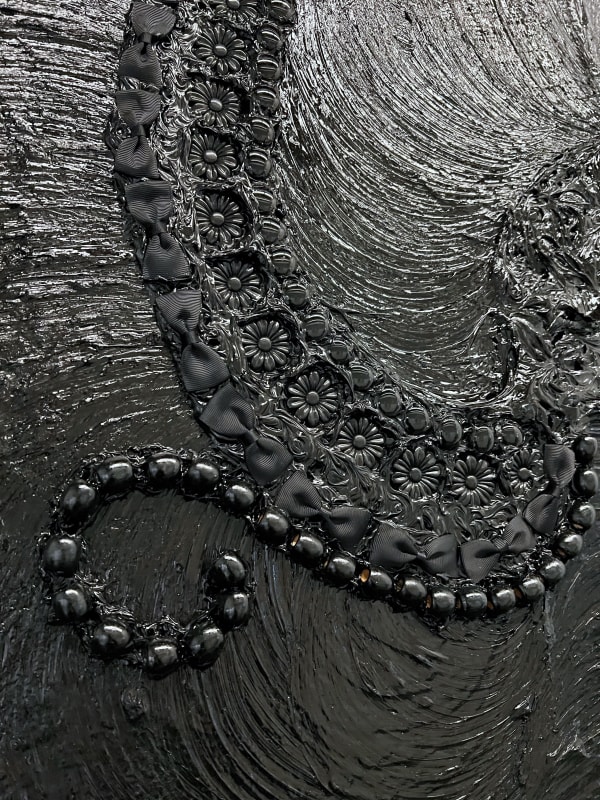
Likewise, building his already caked surfaces in mounded, often
pyramided layers -- (and occasionally strewing them with foreign
objects and materials (flowers, for example), which he then binds
into the painting-objects with yet more wax-infused paint – David
conjures his “Chorten” paintings out of substances so real, so
substantive, so obdurate, that a paintwork can wind up weighing
several hundred pounds. David’s Chortens are as much sculptures –
certainly bas reliefs – as they are paintings, riddled with nooks
and folds, their myriad pits and creases attesting to the vulcanism,
the quasi-geologic drama, of their fabrication.
David asserts the physical profundity of pigment – suspended in oil
and wax alike – no less in his “Golem” paintings. Although these
compositions adhere more conventionally to the picture plane, they
have been formulated with an unsparing use of paint, their surfaces
gnarled and agitated like (if to a lesser extent than) the Chortens.
Such lush, aggressive employment of paint brims with sexy bravado,
but the macho fireworks quickly yield to the experiential presence –
indeed, the presentness – of paint itself.
These two series, Chorten and Golem, are current – and concurrent.
David continues to add to both series, and considers them ongoing
and of equal centrality to his activity as an artist. Moreover,
David considers his recent photographic work connected to the
Golems. Working in several “styles” at once like this may not be the
career-killing anti-strategy it once was, but it still gives pause
to those manifold art-world denizens more comfortable with
pigeonholes than with sensibilities. David demonstrates the risks he
is willing to take in painting; he would rather give it the
elbowroom to expand and reach maximum personal expression than force
it down a straight and narrow path.
This liberal methodology points to one of the most audaciously
complicating factors at work in David’s art, especially at present:
subject matter. The basic focus of David’s work is painting itself;
but “painting itself” includes the history of the medium not just as
it has been developed but as it has been practiced. Its traditions,
that is, the vast inheritance of the myriad painters of the world,
western and otherwise, have left us. And those traditions bear not
simply a history of technical and sensual accomplishment, but a
history of narrative and symbolic expression. Much of the world’s
painting has propagandized for one source of influence or another;
much more has manifested religious sentiment; and more still has
embodied earthly power through unearthly vision. The history of
painting is inextricably part of the history of icons.
No painting (as the abstract expressionists insisted) is free of
subject matter, or even free of iconography. Even the formalists who
dominated the art world prior to David practiced modes of painting
imbued, despite their assertions, with meaning. Issues of
perception, physiological effect, psychological motivation and
viewer interpretation would not disappear at the command of “what
you see is what you see.” David’s generation of painters, the first
to be raised in a visually pervasive popular culture, recognized
this, and generated not simply a post-minimalist approach to
abstraction, but a return to the figure – indeed, a much-ballyhooed
(and much-exploited) “return to painting.” David fed these “returns”
and owes his rapid emergence to them. But he always stood a little
apart from his contemporaries, unable to squeeze comfortably beneath
their simple, even simplistic declarations. He was neither
representational nor abstract, and his icons were at once entirely
obvious and thoroughly obscure. From the first, his painting had a
sculptural presence, and a graphic one; he always approached
painting as a task of making objects and pictures, things you had to
regard as images and simultaneously couldn’t regard as just images
-- surfaces (and even supports) that called attention to themselves
and to the iconic notations they bore.
These notations were usually derived from religious or otherwise
spiritual symbology, and their presence in David’s work often proved
controversial. The reiteration of the cruciform puzzled those who
expected only six-pointed star shapes from the Jewish artist, but it
was the use of the “swastika” of the Incas and the Dravidians – and
the Nazis – that caused the most consternation. He intended it both
as an ironic comment on the Punk use of the image at the time and
also as a signifier to question creativity (in its extreme as the
ultimate self-destructive force). Spiritual symbology wove in and
out of David’s art until the end of the 1980s, when a visit to a
Degas exhibition proved critical. Seeing the show, he wrote, with “a
feminist friend of mine, we had a discussion on the numerous biased
uses of the female nude throughout art history. I realized my own
personal complex issues with women… and [the] utilization of the
female nude would provide me with an image as meaningful as the
cross.” David made a series of photographs of a nude model with
which he began the Jackie series.
To this day, David has not abandoned abstraction; if anything, it
would seem as if the permission he has given himself to work overtly
with the figure. This self consent has given him freedom to continue
painting abstractly and to eliminate referential iconography from
the abstract paintings – not in order to realize a “pure”
abstraction, but to manifest the fact that there is no such thing as
pure abstraction, even the most self-referential, hermetic painted
object brims with metaphorical association. Shapes mean things.
Patterns mean things. Textures mean things. Colors mean things.
Abstract paintings can be as meaningful as flags, although, like
many of his colleagues, David keeps his inferences more obscure.
In fact, the most direct symbolism David now practices can be found
in his figurative works. Just as he turned to the figure to explore
gender issues, many of them personal, David has addressed similar
social issues – race, sexual preference, even physical beauty – in
his photographs. These concerns are equally present in his figural
painting (the Golems); however, the Golems are driven more by
interior passions and private pains. Like the large format Polaroids
and monumental chromogenic photographs, the figurative works embrace
art history, finding in the reiteration of museological icons a
comprehension of personal experience as well as painterly experience
(for an artist like David, of course, painterly experience is part
and parcel of the personal). Just as he has turned to Caravaggio and
Mantegna for the figures in his photographs, he turned to Manet for
the figures in his paintings; and just as Rothko, Reinhardt, and
Stella inform David’s treatment of color and content in his Chortens,
Pollock and Hofmann, Beckmann and Soutine, Velazquez and Rembrandt,
and many other of David’s painter forbearers, inform his treatment
of figure and ground, line and volume, atmosphere and perspective in
the increasingly rich and complex Golem series.
Until now the primary Golem, reiterated to the point of obsession,
has been Manet’s fallen Toreador. David has not simply focused in on
this pivotal art-historical image and its rich mine of formal and
narrative meaning; he has claimed it as a cipher for himself. This
is not an act of mere arrogance, but one of self compassion. In the
fallen figure, unable to arise, David sees his own recent plight.
Still recovering from the substantial loss of mobility and
significant manual dexterity (sustained, ironically enough as a
result of his wax-heating technique), and likely never to regain
full use of his legs and feet, David regards Manet’s bullfighter as
his avatar, wounded, perhaps mortally, in the effort to perfect his
art.
Importantly, David does not regard his effort as wasted, any more
than the toreador would have considered his sacrifice inglorious.
Required to abandon painting at the outset of his recovery, David
turned to photography to continue exploring the images and issues of
painting; and once he was back on his feet, as it were, he resumed
painting. “Painting has become a dangerous place for me,” David
testifies, “and is now a very slow and painstaking process.” But,
even though he could (and more than his doctors think he should)
give his burgeoning photographic work his all, chose to return to
his first medium, encaustic paining. Painting is David’s soul mate
and savior, as he is painting’s. He has returned to its side,
humbled and renewed.
Many commentators are again predicting the death of painting; the
digital age supposedly marks the eventual end of such an
un-electronic discipline. But the ubiquity of the virtual only
serves to heighten our taste and need, for the actual – and there is
nothing more actual and also more virtual (even in its iconographic
and philosophic complexity), than painting. Painting is currently
being saved and sustained by a newly hungry audience that spends
hours before a hard, impassive monitor screen and needs something
juicy, intricate, and riddled with meaning to add depth to its
experience of life. With audiences thus primed, painters do not now
need to save painting; they need only practice it faithfully.
Michael David has proven his faith in and devotion to painting, to
its history, its facture, and its manufacture. His is the kind – the
kinds – of painting the new audience seeks.
Los Angeles
December 2006 |