Dreams, Fragments, Females:
Leiko Ikemura's Body Imagery
by Donald Kuspit
Why should the
unconscious, which possesses the means for awareness
of our bodily intimacy, be blocked when it comes to the vagina?
Janine Chasseguet-Smirgel, "Freud and Female
Sexuality: The Consideration of Some Blind Spots in the
Exploration of the 'Dark Continent' "(1)
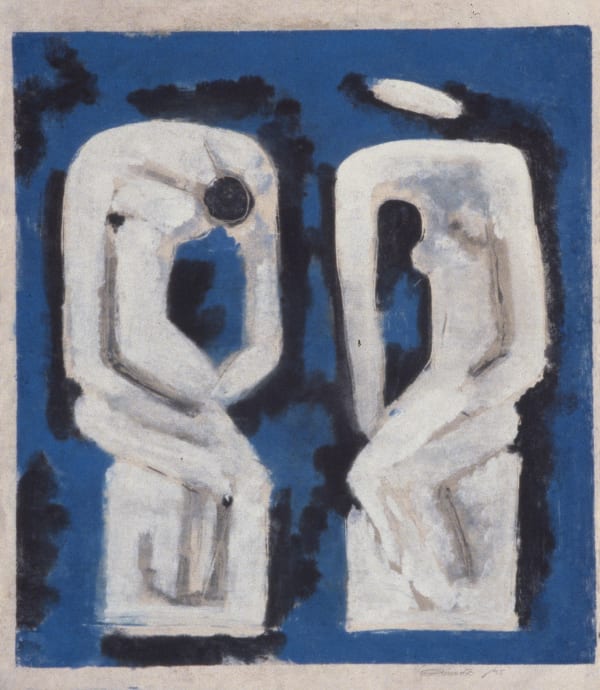
Little girls, grown women, sometimes together, suggesting mother and
daughter, sometimes apart, suggesting loneliness--this is the
constant theme in Leiko Ikemura's art. Repeated over and over, with
an obsessive versatility and variation, Ikemura's females are
clearly emanations from her unconscious. They are invariably
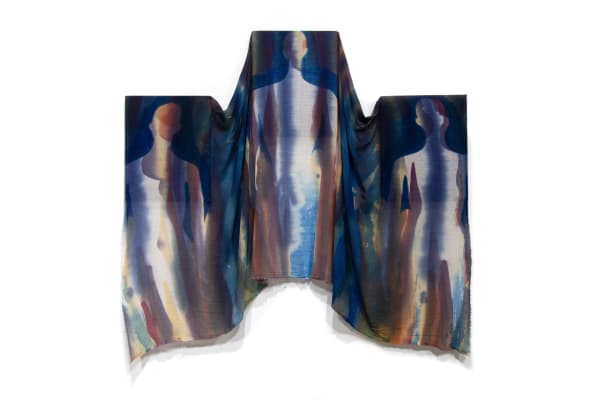
haunting, dreamlike, often no more than an elusive, almost
immaterial trace in her paintings and watercolors--a ghostly
revelation of a figure, a peculiarly muted hallucination, as Out
of the Shadow, 2000 and Standing Sideways in Dark Red,
2000-2001 indicate. These works have the same intense blurriness as
Redon's dream imagery: they too are created of nuances of
color--ingenious touches of delicate color, instantly communicating
a curiously melancholy if also sensual mood. They occupy an
important place in the history of what Redon called "suggestive
art," his modernist version of visionary spiritual art.
Ikemura's terracotta sculptures are much more conspicuously
material, but also with the same haunting interiority--the same
blurred, moody flesh, so reminiscent of Medoro Rosso's sculptures,
as Ikemura's terracotta heads of the mid-nineties make clear.
Sometimes Ikemura¹s females are standing, more often they are
reclining, as though asleep and dreaming. Crucially, from a formal
point of view, they are all fragments--incomplete bodies, sometimes
missing legs, sometimes arms, and frequently featureless. This gives
them an archaeological look, as though they were ruins excavated
from some ancient burial site--trophies of the past, memorable
relics, found by chance. But they are not simply the victims of
time: they seem to have been wounded by life-doomed to be
wounded--as the tearful Dolores (One-Legged), 1998
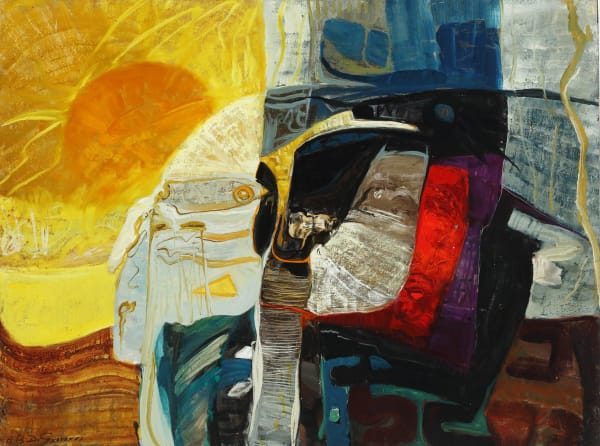
suggests. "When you are sad," Ikemura wrote, in advice to the mother
and children in her painting Day, 2000-2001, "walk behind
the orange colored shadows and observe the blue horizon," but the
sadness and the sunset remain. Similar words accompany her sculpture
Catwoman with Tail, 2001: "we have hidden and forgotten our
wings on our backs." Clearly they've been clipped. "See the world
completely from below, almost creeping, then you can fly in the
cosmos," Ikemura writes, referring to her sculpture Leaning on
the Eyes, 1997. (The German title, Sich auf die Augen stützend,
is more and ambiguous and resonant, for 'stützen' can mean taken
aback, falter, or clip, a point made more explicit in Yellow
Figure with Three Arms, 1996, two in her eyes and one in her
mouth.) But such flight is clearly escapist, like observing the blue
horizon--where heaven and earth, infinite and finite space meet,
evoking the feeling of the sublime--as many figures do in Caspar
David Friedrich's paintings. Ikemura's flights of fancy--her
aesthetic fantasies of female identity--enact rather than relieve
her suffering.
Dolores's pathos is emblematic of the impacted emotionality of
virtually all the figures. They may be particular individuals, but
their featurelessness gives them an archetypal look--dramatically in
the unexpectedly forceful terracotta figures of 2004, if, more
generally, fatalistically. Indeed, Ikemura's figures seem to be
resigned to their fate--the fate of being female. Whether inspired
by Japanese models, as in the sculptures Figura Lu, 2002
and Figura Li, 2002-2003, or typically Western, as in the
oil paintings Duck Tears I and II, both
2004, and standing together or apart--sometimes in the same picture,
as in Ocean III (Between Horizons), 2000-2001--Ikemura's
females are peculiarly insular, poignant, and passive, suggesting an
incompletely realized yet unavoidable femininity. Such vigorous,
hyperactive figures as Ma-San, Miu-San,Wu-San, and
Ho-San, all 2004--they are mounted on phallic pedestals,
indeed, seem to grow out of them, as in Pu-San and
Chichi-San, both 2004, where the column becomes a kind of tail
(more dragon-like than cat-like to my eyes)--are the rare exception
that proves the rule.
Now the startling thing about such terracotta sculptures as
Lying with the Face Holding and Lying in Cherry-red,
both 1997, Lying Figure with Face on Miko and Lying in
Turkish Dress, both 1998, is the huge cavity at the base of the
figure. The same cavity appears in Lying, 1996 and in each
of the figures in Upon the Other, 1997, and, disastrously,
in Yellow Dress with Orange Bird, 1995 and Double
Figure with Bird in Arm, 1998, where the cavity of the body is
visible through the empty space--enormous hole—where the missing
head should be. From the beginning Ikemura had a troubled sense of
body, as the headless Baby Green, 1991 and White Figure
I and II, both 1992 suggest, and the trouble seems to
have grown greater.
Beneath the dress is a gaping hole through which one can see the
hollowness of the figure. Who will--indeed, can--fill it? Is it a
symbol of female unfulfillment? Who dares enter what Freud called
the dark continent of the female body? Is it a cornucopia of wonders
or a Pandora's box of evils, whatever the hope at its bottom? But
does an abyss have a bottom? Who dares penetrate the depths of the
female underworld, get to the bottom of the female mystery? Only the
all-powerful phallus--the really bold, daring, heroic male, driven
by both ambition and lust--dare do so. One immediately thinks of a
sentence in Freud's Three Essays on Sexuality (1905): "The
processes at puberty thus establish the primacy of the genital
zones; and, in a man, the penis, which has now become capable of
erection, presses forward insistently towards the new sexual
aim--penetration into a cavity."(2) The cavity in Ikemura's lying
female figures is an elaboration--a fantasy enlargement--of an
engulfing vagina. At one end of the figure, the small
head--sometimes damaged, as though crushed--at the other end the
huge genital cavity, exhibited for all to see, and enter if they
dare. There is nothing repellent about it--it may signal castration
to a neurotic male, but there is nothing ugly about it--but it is
not exactly inviting. Indeed, it is as forlorn, empty, and
abandoned--unresponsive and unreceptive--as the figure herself,
abjectly lying on her face, as though beaten down and defeated by
life. She may wear a blue dress or a cherry-red dress, but they do
not make her happy. The colors are soft and muted, as though faded.
She is in effect performing her own death--a living death, no doubt,
but still a death. Indeed, the slabs on which the sculptures were
displayed when they were exhibited in the Japanese Pavilion of the
1999 Melbourne International Biennial resemble the slabs on which
bodies are laid out in a morgue.
The flat slabs can be read as a minimalist foil to the rounded
figures, giving the works a post-modernist character--abstract
geometry and figurative representation exist side by side in the
same work, abruptly juxtaposed rather than harmoniously integrated.
But the conflict suggests the emotional conflict between formal
control and abandonment to emotion evident in Ikemura's works. While
Ikemura's work shows the influence of Japanese culture and art, with
its haiku-like restraint and intensity--concentration building to a
climactic epiphany (she acknowledges the influence of haiku poetry,
as an idea if not a form)--she began her career as a German
Neo-Expressionist, as a number of 1991 works make clear. She
eventually established her independence by dealing with her feminine
and Japanese identity, although her paintings remain informed by
Rothkoesque abstraction and, more subtly, the romantic naturalism of
European landscape painting, all of which have been transformed to
serve Ikemura's sense of idiosyncratic and multicultural--finally
transcultural--identity. She has in effect integrated Japanese and
German, and more broadly modernist and traditional, ideas of art in
her own unique way. (Prominent among the 1991 works are
Squatting with Dark Hair, 1991 and the various O.T.-W.T
paintings. Their figurines suggest the influence of Georg Baselitz's
pandemonium imagery and perhaps Jean Dubuffet's art brut imagery,
while Ikemura's watercolors have a certain affinity with those of
Beuys. Her Head Footer, also 1991 clearly shows the
influence of Horst Antes's breakthroughKopffüssler figures,
generally regarded as the first significant postwar German
Neo-Expressionist figuration.)
Where, then, is the heroic penis--the mythical phallus--that dares
enter this dark female cave? It is striking that nowhere in
Ikemura's oeuvre is there a painting or sculpture of a man. There
are only females, adolescent or motherly. All of them are implicitly
self-symbols--symbols of Ikemura's own dialectical femininity. Each
female figure is a cosmos unto itself--"sea after dying, sea after
giving birth," Ikemura has written—and together they form a cosmos
in no need of men. Man has not simply been ousted, but he doesn't
exist--indeed, never can exist in Ikemura's atmospheric paradise.
Ikemura's paintings strongly suggest a kind of "oceanic
experience"--a fragile yet seamless merging with the cosmos in which
one forfeits one's individuality, and, more deeply, ecstatically
loses one's sense of being an independent person or autonomous self,
dispensed with in the "mystical" experience as an unnecessary
illusion. Thus Ikemura's figures dissolve into illusions--vivid,
magical illusions, but nonetheless transient illusions in the
timeless oceanic atmosphere, which seems to have a sublime substance
of its own.
Freud has argued that oceanic experience involves unconscious
regression to the womb--archaic merger with the archaic mother. It
is a fantasy merger with the imagined penis of the so-called phallic
woman--the pre-Oedipal, all-powerful mother on whom the infant's
life depends. Indeed, dependence--amae, the so-called dependency
syndrome(3)--is a subtext of Ikemura's imagery: again and again we
see mature women and immature girls standing together, as though
emotionally clinging to and re-fueling one another, to use the
psychoanalyst Margaret Mahler's concept. The tail that many of
Ikemura's woman possesses suggests that they are phallic mothers.
(The horn-like ears of Hare Woman, 1990-91--an
acknowledgement of the influence of Joseph Beuys, who regarded the
hare as a mercurial messenger between the underworld and upper
world--are its antecedent.) Indeed, Ikemura's phallic women are as
dynamic and powerful--full of aggressive strength--as the penis at
the moment of its penetration into vaginal cavity, where it is
contained and spends its power. But the phallic woman—the eternal
feminine that is the all-encompassing mother--never loses her power
and authority in the infantile part of the mind. They are
mythologized into the eternally erect phallus of the Magna Mater.
Ikemura's adolescent girls cannot completely separate from this
awesome, sacred figure even as they cannot unequivocally identify
with her—although Ikemura does by way of her creative power, that
is, the power of giving birth to subtle works of art. When they do
separate, they are lonely and melancholy, full of the unfathomable
sadness emblematic of her absence—the depressive misery of a
mysterious loss that has happened in the mythically remote past of
infancy, as the psychoanalyst Charles Brenner has suggested. Ikemura,
then, is the adolescent girl, the motherly woman, and the sublime
atmosphere--they are all parts of the personal drama she enacts in
her art. The adolescent girl symbolizes psychosexual immaturity, the
catwomen are in principle mature phallic mothers, and the erotic
oceanic atmosphere that engulfs both--it informs their flesh in the
sculptures--is the medium of their merger. Ikemura's forlorn girls
suffer from separation anxiety, which they "heal" by regressing to
the mother for whom they long.
The Miko doll that appears in many of Ikemura's works is a symbol of
the problem of separation-individuation they address. The
obsessional redundancy of the works suggests the depth of the
problem. The doll is a superb example of what the psychoanalyst
Donald Winnicott called a transitional object--something invested
with the mother's aura and unconscious meaning yet something that
the child experiences as objectively the case. Ikemura's Miko doll
is her security blanket--a reality that is found in the world but
that is also emotionally created. The poignant, enigmatic beauty of
Ikemura's paintings and sculptures--inward as well as outward
beauty--is an indication of their emotional profundity. They are a
profound reminder of the vicissitudes of female identity.
Notes
(1)Janine Chasseguet-Smirgel, Sexuality and Mind: The Role of the
Father and the Mother in the Psyche (New York and London: New York
University Press, 1986), p. 12
(2)Quoted in Ibid., p. 11
(3)Ikemura's works seem to represent the Japanese dependency
syndrome in all its complexity. Robert C. Christopher, The Japanese
Mind (New York: Fawcett Columbine, 1983), p. 69 notes that the amae
"relationship is as binding psychologically upon the protector as on
the protected. This combination of constant maternal attention and
all-embracing love gives Japanese children an enviable sense of
security in their early years, but...it considerably complicates
male-female relations, since both men and woman are always
unconsciously trying to find someone who will love and cherish them
as uncritically as Mama professed to--which, in most cases, is
obviously a foredoomed effort" (p. 68). One might add, as Ikemura's
work makes clear, it impacts on one's sense of identity at the
deepest level--the level of the body ego, which Freud regarded as
the first ego and as such the foundation on which every other sense
of ego is built. One senses that Ikemura is constantly
rebuilding--struggling to re-create--a body ego that keeps
collapsing, as the seemingly age-old traces of damage that mark it
suggest. |