|
 |
|
 |
|
Born in Manhattan
in 1951, the son of a Czech architect and Viennese writer who fled
the Holocaust, Gary Komarin received a graduate teaching fellowship
at Boston University where he studied with Philip Guston. Komarin
was offered his first University teaching position at Hobart &
William Smith Colleges in 1978. He has subsequently taught at The
University of Oregon, Southern Methodist University, and The
University of Iowa. Komarin was nominated for and received The Joan
Mitchell Prize in Painting in 1999. He has also received the Edward
Albee Foundation Fellowship in Painting, The Elizabeth Foundation,
New York Grant in Painting, The Rutgers University Fellowship in
Innovative Printmaking, a Grant from the New York Foundation for the
Arts, and the Philip Hulitar Award in Painting in 1988. Komarin has
been invited to make prints and encaustic paintings on paper at
Garner Tullis in New York, by Tandem Press at the University of
Wisconsin, at Aurobora Press in San Francisco, and by Segura Press
in Tempe, Arizona. He has been exhibiting his work here and abroad
since 1979 and has had solo exhibitions at The Lowe Gallery in
Atlanta, Maxwell Davidson in New York, Meredith Long in Houston, and
Herbert Palmer in Los Angeles, among others. Komarin's work has also
been exhibited at the Museum of Art at the University of Oregon, the
Meadows Museum at Southern Methodist University, and the Newark
Museum. His work will soon be seen at Kunst Art in Zurich in March
2002. He will also be having a one-man show in Zurich this spring.
Komarin's paintings are in numerous private, corporate, and museum
collections including: Microsoft, AT&T, The Nordstrom Corporation,
The Museum of Fine Arts in Houston, and the Montclair Museum.
EXHIBITION
REVIEW
"Gary Komarin"
Published in Art in America
Now in midcareer, New York born
artist
Gary Komarin makes works that
owe as much to Color Field
painting as to his oft-cited
mentor, Philip Guston.
While scrawled Guston-like
tropes are definitely a hallmark
of Komarin's work, they are
balanced by deep, thoughtful
breaths in between.
Enchanced by an energetic use of
color, Komarin's images rely on
the tension between the
spontaneous and the considered,
the accidental and the
consciously executed, for their
striking vitality. The
artist hides nothing - his
methods are perfectly evidence
as he covers and uncovers,
delineates and sweeps over the
shapes on his canvas. And
what are these shapes?
They could be things - boats,
bottles, boxes and hats - or
they might just as easily refer
to nothing in particular.
Precisely positioned on the
border between image and
abstraction, Komarin's forms
offer what John Elderfield,
speaking of Martin Puryear's
sculpture, so eloquently
referred to as a 'familiarity
that resists recognition.'
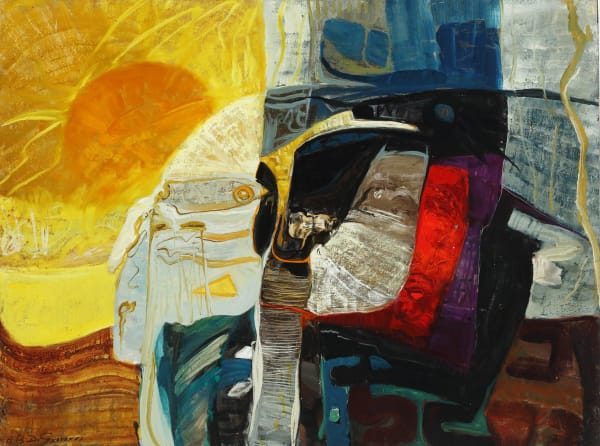
All of the paintings in this
exhibition were from 2006 or
2007, large-scale, often with a
surface of acrylic paint on raw
canvas, or house paint mixed
with spackle - combinations that
provide a particularly matte
ground for Komarin's drips,
scrawls and idiosyncratic
fillips of enamel, crayon, oil
pastel and other assorted
mediums. Rimmed with hints
of orange at the top and bottom,
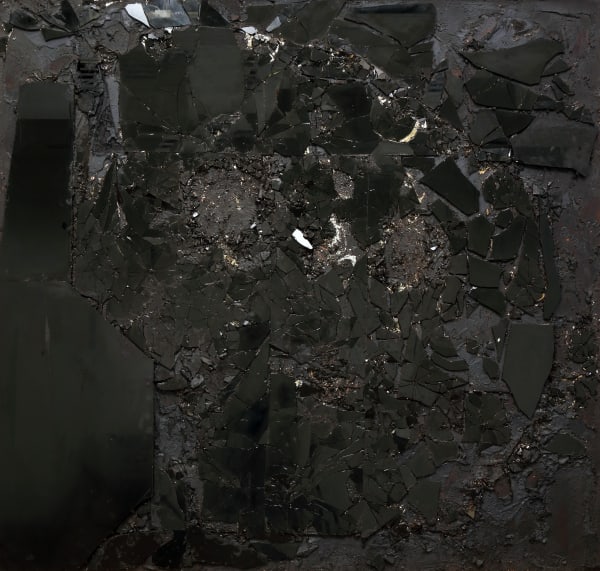
the black surface of 'The
Disappointed Mistress #12'
(2007, 80 by 68 inches) is so
flat that it's almost like a
blackboard - but an improbably
transparent one. As the
eye adjusts to the dark, faint
crayon lines, the ghostly layers
of under- and over-painting
slowly come into focus, until
what originally looked like a
very simple composition becomes
infinitely more complex.
Other works are not so reticent,
but declare themselves
immediately with strident
backgrounds of red, azure blue
or grass green, which are in
turn overlaid with big blocks of
strong, contrasting color and
bold, barely controlled gestures
of crayon or pigment.
Sometimes delicate, other times
crude, these shapes are as
confident as they are enigmatic.
There is no narrative here, no
underlying message, except for
the process, with its
revelations, both conscious and
unconscious. Any single
interpretation is by design
subject to change. In many
ways, what you see is what you
get, except that the next time
you look, what you get may be
completely different.
EXHIBITION
REVIEW
"Paintings Do the Talking,
Without Too Many Specifics"
Published in the New York Times
(February 27, 2000)
Written by Barry Schwabsky
Gary Komarin doesn't want to say
too much about his paintings,
but he's not brusque about it.
He's almost apologetic,
actually, but in the course of
explaining why he'd rather let
the paintings speak for
themselves, he ends up telling
quite a bit.
Oddly enough, the paintings are
very much the same way.
Seemingly imprecise in their
imagery, austere in palette,
self-absorbed in feeling, their
surfaces gritty and
uningratiating, they can
nevertheless become eloquent,
for those patient enough to give
them time.
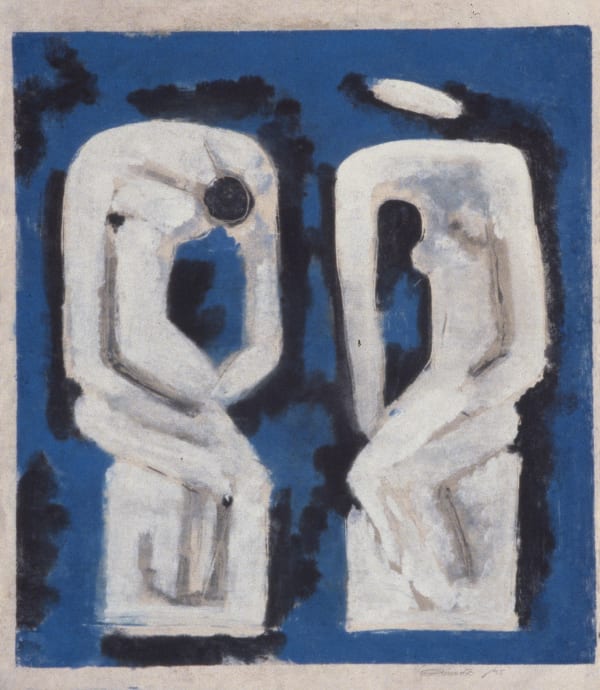
Although abstract, Mr. Komarin's
paintings sometimes contain
shapes that are quite legible -
a wig or a hat, for instance -
but more often they tend to
suggest many things without
getting quite specific about any
of them. And in
conversation, the artist is not
eager to make them any more
specific. The forms
resonate when they are at once
strange and familiar.
"I don't know what this form
is," Mr. Komarin says, walking
across the gallery to indicate
'Estragon,' a painting from
1998. "Maybe it reminds me
of a bongo - but if I start to
think of it as a bongo, that
calls up all kinds of
associations that are irrelevant
to the painting. So I try
to dissociate from that while
I'm working on a painting.
"It would be misleading to put a
name to these forms. As a
viewer you bring something
different to them, depending on
your own experience - depending
on what you saw last week, or
what you read, or maybe what you
ate."
Often the forms echo the
awkwardness of children's art.
"Most artists love children's
drawings because they're so
direct and free," Mr. Komarin
says. But his nebulous,
seemingly half-formed or
half-identified shapes are meant
less to recall they way children
draw than their experience of
seeing things without knowing
what they are, what he calls "a
childlike sense of wonder and
bafflement."
When asked whether a recurrent
form in some of his most recent
paintings, a simple loop
attached to a vertical line, is
really meant to be seen as a
noose, Mr. Komarin acknowledges
that he sees it that way too,
explaining that he'd been
thinking of the child's word
game hangman. But he
doesn't disavow the sinister
overtones of the image,
speculating that the game's
origins are linked to the fact
that hangings were once a form
of public spectacle or popular
entertainment.
Although Mr. Komarin has lived
in Flanders for the last 14
years, his tough, somewhat
taciturn manner still evokes New
York City, where he was born and
grew up. He has been
exhibiting his work nationally
since 1981, but 2000 looks to be
his busiest year ever.
Along with this exhibition, he
is also doing one-person shows
this year in Atlanta, Des
Moines, Palm Springs, Calif.,
and Washington.
After studying at Albany State
University, he went on to get a
master of fine arts at Boston
University, where he studied
with Philip Guston, the Abstract
Expressionist painter who
shocked his contemporaries in
1970 with the first of the
crudely figurative canvases that
occupied him until his death a
decade later. The critic
Hilton Kramer, for instance,
derided him as "a mandarin
masquerading as a stumblebum,"
but Guston's late work turned
out to be enormously influential
on younger artists.
As a teacher, Mr. Komarin
recalls, "Guston made painting
seem like a door to the unknown
- a way to explore yourself, the
world, the human condition.
He wanted you to paint what you
don't know rather than what you
know." Guston's lesson in
cultivating the unknown has
clearly stuck with Mr. Komarin.
And on a more superficial level,
the teacher's peculiar sense of
form can also still be traced in
his former student's work - in
the way Mr. Komarin's bulbous
forms can seem to echo, in an
abstract way, the cigars,
cyclopean heads and naked light
bulbs in Guston's paintings.
Of course Guston is hardly the
only predecessor whose influence
has marked Mr. Komarin's
canvases. The fact that
many shapes he uses resemble
jars and vessels becomes more
explicable after he speaks of
how much he admires Giorgio
Morandi, the Italian modernist
best known for his austere,
intimate still lifes of bottles
and other ordinary objects.
"Morandi did so much with space,
forms, the way things touch,"
Mr. Komarin explains.
Mr. Komarin himself started out
as a still-life painter rather
than an abstractionist.
"That's because I like using
what's at hand," he says, and
this is true as much of his
materials as of his imagery.
He points to one painting and
shows how a vertical line from
top to bottom is the seam that
happened to be in the piece of
canvas tarpaulin he'd found in a
hardware store and decided to
use instead of fine artist's
canvas. Often buried in
his paint are post cards and
other stray pieces of paper he's
collaged onto the surface.
"Some painters cant' work
without special paints they have
to order from Holland," he says.
"I like good materials too, but
if I were stuck in the studio
with just brown and white paint
and a box of dried oatmeal I'd
figure out something I could do
with them." |
|
 |
 |
 |
 |
|
 |
|
catalogue essay
ICONOCLASTIC ABSTRACTION
by Donald Kuspit
Published in the Bill Lowe Gallery Catalogue - Gary Komarin: Her
Dutch Shoes Treated Her Well
(April 2008)
Can abstraction survive? That's the question with which Mark
Rosenthal concludes his magisterial study of Abstraction in the
Twentieth Century (1). Now that abstraction has become established,
the issue is no longer whether it can maintain the sense of 'risk'
and 'freedom' that Rosenthal notes were its hallmarks, but if it can
avoid becoming 'hidebound' in the twenty-first century. Now
that it is no longer 'experimental,' can it continue to be vital?
Or, as I would put it, can it continue to evolve, becoming something
other than the labored formalism in which Rosenthal suggests it
threatens to dead-end?
Komarin shows us one way in which it can: he breathes quirky new
life into abstraction by making it witty. He takes what was
once 'forbidding' and 'hermetic' - Rosenthal's terms for abstraction
in its heroic inaugural period - and makes it ironically lyric by
making it playful. He returns gesturalism to its origins in
landscape, but the abstract landscape is no longer 'apocalyptic,' as
Kandinsky's have been said to be, but whimsical. He takes what
had become closed systems of geometrical and non-geometrical
abstractions and interbreeds them. The result is a kind of
hybrid abstraction, less heavy-handed than traditional abstraction
but still emotionally serious. It is an overtly hedonistic
abstraction, rather than confrontational in the style of the Old
Abstract Masters; there is a power in pleasure they, in their
Puritanism, could not appreciate. Komarin also has the benefit
of aftersight: he orchestrates the whole development of abstraction,
bringing its different musical strands together in a sort of grandly
ironical musical painting - an ironically symphonic painting not
unlike Satie's witty music.
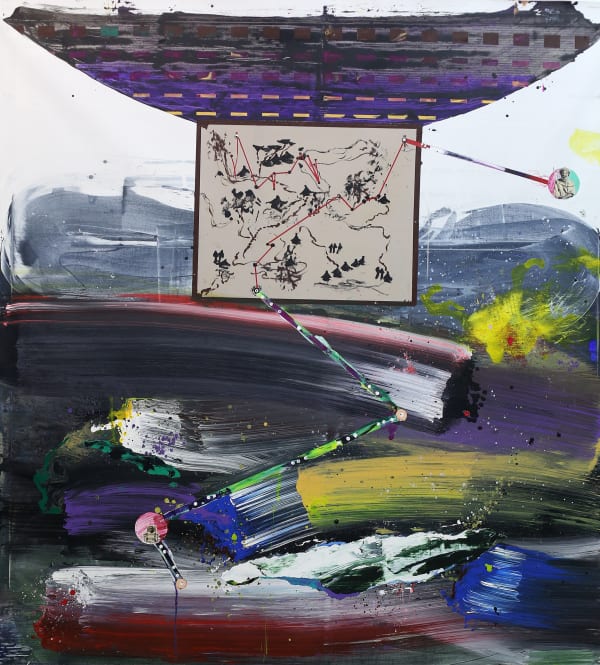
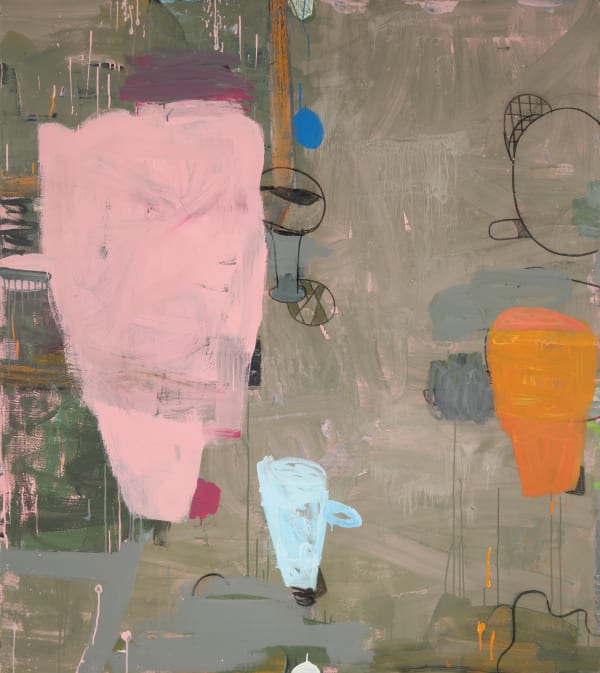
The point is clearly made by 'Van Dyke's Van Dyke' (2007), not
simply by way of the clever title, which suggests that Komarin's
abstract painting has an elegance similar to that of Van Dyck's
regal portraits, but by way of the witty play of shapes. Some
are quickly and casually drawn, as though scribbled in a child's
sketchbook or on a writing pad. These shapes seem easily
changed - they are on the verge of being free form, yet also
readable as images (a sort of sailboat in the upper right corner, a
kind of house in the lower right corner) - and even erasable.
There are also painterly islands of dense color - seemingly solid
ground on an otherwise quixotic field of darkish gray, marked by
little eruptions of bright color. These eccentrically shaped
forms - they seem to be slowly germinating, however concentrated in
themselves - are ironic reprises of the patch (tache) that has been
the mainstay of modernist painting since it was first acknowledged
by critics of Manet's painting.
Komarin's painting is a reprise of 'thin-skinned' color field
painting and 'thick-skinned' gestural painting, with geometrical
odds and ends added by way of linear drawings. But it is a
delicately clever reprise, opening up new expressive as well as
perceptual territory. The three painterly patches - pink and
dark pink, capriciously elongated into ellipses, and a squarish
patch of pitch black - form an eccentrically open system (a sort of
orange colored cross-like star emerges from the 'negative' space
between them, marking their center). They are counterbalanced
by the closed system of the green triangle on which the black patch
is dubiously placed. The triangle itself is precariously
perched on the tower-like tip of a flimsy rectangle. Hovering
high above it is the sailboat, combining the triangle and rectangle
forms (both the same soft color as the rectangle below). There
is a gentle tension between the three triangular units, as well as
between the flat surface on which they appear, like mirages in a
void. For all its brooding atmospherics and sensual touches,
the surface remains peculiarly inviolable. It supports the
dallying shapes, innocently floating on its flatness - linear and
painterly jottings on a deep sea, visual straws for the spectator to
grasp. Komarin's shapes linger on his surface, inviting us to
enjoy their paradox: child-like drawings and painterly markings in a
witty arrangement. Innocence and sophistication subliminally
align in Komarin's painting.
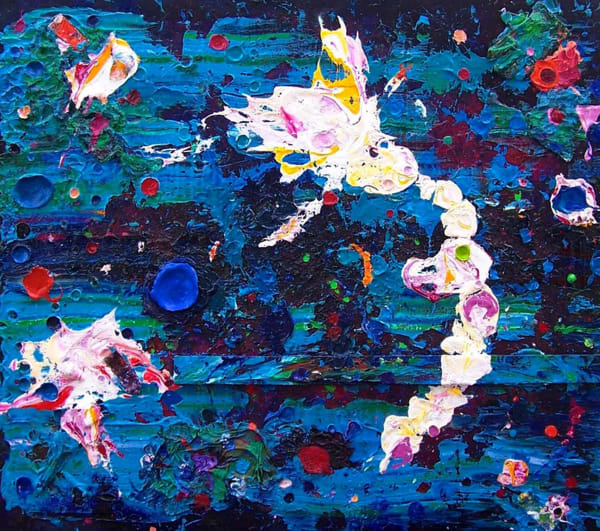
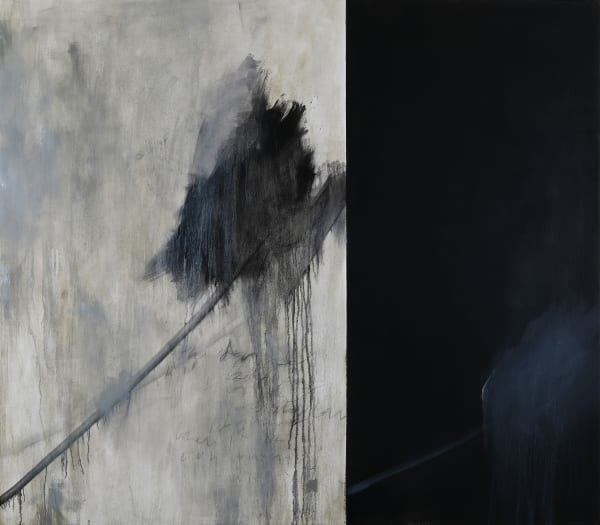
'Dale' and 'A Suite of Blue Sea, Peter's Pond Lake' (both 2007),
make the landscape anchor of Komarin's abstraction clear, even as
they show it veer energetically towards ironical purity. There
are the same gestural patches, now compacted into a sort of
composite painterly material. But the drips, the seemingly
slapdash brushwork, the flowing together of broad fields of excited
color, have an ingenious flair. Purity is pushed toward its
contradictory limits - perhaps most evident in the abrupt difference
between the large plane of dripping black and the smaller plane of
luminous blue in the latter painting - reminding us of the
conflicted consciousness that informs traditional abstraction.
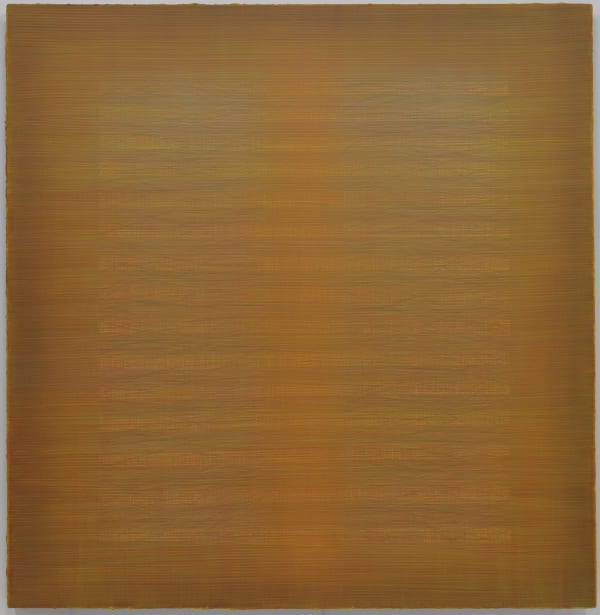
There is much more harmony in the glowing yellow field of 'A Suite
of Blue Sea, Bishop's Gate' (2007) - the same sea in an altogether
different light? - but there is the same irksome tension and
peculiarly 'introverted' and sketchy shapes, holding their own as
they drift on the flat sea. Its strong underlying current
becomes explicit in the meandering lines of 'A Suite of Blue Sea
with French Wig' (2007), a sort of unraveling of the drawn shapes,
although the complex color patches remains intact. The
transparency of the drawn shapes and the opaqueness of the color
patches makes for another level of formal and expressive tension.
One can call Komarin's abstract paintings quirky formalism, if one
needs a label, but I think it is better to think of them as a smart
synthesis of spontaneous gesture, geometric composition, and iconic
form, with a certain tendency to monochrome. These are the
four 'basic formal options' of abstract painting, as Rosenthal says,
and in Komarin's paintings we find them mixed to lyrically absurd
effect. 'Incident as Osbourne Grove' (2007) makes the point
clearly: its (near) monochromatic surface - 'Hill' and 'Rue Madame
in Red' (both 2007) are almost completely monochromatic - is marked
by spontaneous gestural 'incidents' that take more or less
geometrical form, becoming peculiarly iconic or emblematic.
Process painting and structural painting uniquely and inevitably
fuse to insinuating expressive instinct.
Some of Komarin's paintings are manifestly erotic, others latently
melancholy, but the point I want to make is that Komarin is an
esthetic fundamentalist with an ironic twist. The twist
prevents this work from becoming decoratively empty - the fate of so
much abstract art, as the theorist Max Horkheimer remarked.
Komarin engages the decorative but finesses it, as the critic
Clement Greenberg said Matisse did; Komarin has a certain debt to
Matisse, and to French 'luxury' painting in general, as Greenberg
called it. A good part of the irony is that Komarin's
paintings hover indeterminately on the boundary between purity and
imagery. As soon as they seem one-sidedly abstract, they
become 'impressions' of a natural environment. This doubleness
keeps them fresh even as it confirms their traditional modernism.
For Komarin reminds us that abstraction has its roots in
Impressionism, and Impressionism is rooted in the preoccupation with
the painterly metier implicit in the Realism of Courbet and Manet.
Komarin is a modernist painter, that is, he is acutely aware of his
medium and takes a certain 'critical' stance to the planar surface,
but he is also aware that a modernist surface that lacks a poetic
charge becomes a shallow facade. One might say that Komarin
has re-organized increasingly mechanical and self-sufficient
modernist painting by reminding us of its broadly based heritage in
romantic naturalism, that is, in emotional attunement and caring
observation of nature. Indeed, Komarin renews the fantasy of
nature in which abstraction is deeply rooted.
Nature contradicts itself by way of changing atmosphere and light,
even as it remains self-regulating. The apparent randomness or
irregularity within its regularity suggests that nature is in
subliminal evolutionary process. I think that what makes
Komarin's paintings important is that they harness the paradoxical
randomness of nature, furthering the evolution of imaginative
abstraction. Abstraction had become too 'regular' and
uninspired - set in its ways - for its own creative good; it needed
an infusion of chance to arouse it from complacency, and renew its
visionary power. Abstraction is no longer revolutionary, but
it can still be a breath of fresh visual air. One might say
that Komarin imaginatively searches out fresh modes of randomness,
as nature seems to. The evolutionist Dean Keith Simonton notes
that evolutionary change begins with 'chance permutation' of
'fundamental units (in painting - color and line) that can be
manipulated in some manner... These elements must be free to enter
into various combinations" (2). The elements are identical,
but arranged in different ways, to what Simonton calls
'iconoclastic' creative effect.
But then these 'heterogeneous variations' must be 'subjected to a
consistent selection process' if they are to make 'adaptive' sense.
I am suggesting that Komarin's witty abstraction, with its seemingly
chance interplay of formal elements in iconoclastic combinations, is
a creative way of adapting to and rejuvenating an abstraction that
has become decadent by way of becoming over-familiar and comfortable
with itself, and with that esthetically stale, emotionally flat, and
perceptually unchallenging. His paintings are a mutation of
abstraction - a necessary mutation if it is to survive in convincing
form - if it is not to become hackneyed and meaningless.
Komarin's abstract paintings are all the more engaging because they
exist on the boundary between subjective and objective statement.
Simonton writes: "On a subjective plane, the more stable a
permutation, the more attention it commands in consciousness; the
unstable permutations are too fleeting to rise above unconscious
level of processing." We process Komarin's painting
simultaneously consciously and unconsciously, experiencing them as
both ingeniously stable compositions - stabilized by their
dialecticized gesture and geometry, functioning as spontaneous
figures on an atmospheric ground, transcendentally distant yet
intimate, like nature itself - and unstable permutations of
transient elements. It is their fleeting appearance - their
sense of being in timely process - that makes them emotionally
engaging, even as their combination in an abstract composition gives
them a peculiar permanence and timelessness.
Notes:
(1) Mark Rosenthal, Abstraction in the Twentieth Century: Total
Risk, Freedom, Discipline (New York: Solomon R. Guggenheim Museum,
1996)
(2) Dean Keith Simonton, "Creativity, Leadership, and Chance," The
Nature of Creativity, ed. Robert J. Sternberg (New York: Cambridge
University Press, 1988), 389-90
critical essay
by Hamlett Dobbins
Director, Clough-Hanson Gallery
Rhodes College, Memphis, TennesseeGary Komarin does
in his paintings what acrobats do on the high wire: there is a
constant balancing act between sophistication and simplicity,
between cartoon-like expressionism and eloquent abstraction. His
images at first seem simple and even awkward, but given enough time,
the complexity of the parts reveals itself and the viewer begins to
see Komarin's relentless artistic cunning. The gritty surfaces have
a sense of urgency that is conveyed by the way he uses quick-drying
materials: tempera, waterbased enamel, graphite, or whatever happens
to be at hand. This groping, scratching, addition, and subtraction
serve to document the struggle between chaos and control. The
process points to this artist's ability to not only use
'painting-as-noun' to describe the place he finds, but also how
'painting-as-verb' got him there. The image that survives the
process is determined by Komarin's search for an indescribable
"rightness." By relentlessly pushing himself in the studio, he
challenges the viewer with fresh paintings that feel pure and
unrehearsed. They are at once truthful and daring.
Each painting's unique palette extends the notion that a particular
quandary must be met with an ever shifting array of solutions. The
colors of certain expanses are arrived at by mixing one pile of
paint into another, directly on the canvas. His more labored-over
surfaces have dense, savory planes while either super-graphic-black
or sharp, vibrant hues are used to describe the most direct,
unrepentant stroke. Komarin's mix of rich, subtly shifting colors
and the hot, acidic pigments help each painting produce a specific
combination of hues to create its precise flavor.
Like a vigorous game of Pictionary between Guston, Twombly, and
Motherwell, Komarin deftly uses shape and form to play with the
moment of recognition: when does a mark stop being a mark and become
an object? The viewer is left with the enviable task of sorting
through the signposts in this painterly landscape. The reoccurring
shapes in his work - the wig, the cake, the vessel -- lend
themselves to different levels of interpretation. At the same time,
these images create a sense of absurdity in the painting: they are
imprecise, quirky, and even romantically fanciful.
Komarin's stalwart images have an epic quality that grips the viewer
with the idea that he or she is looking at a contemporary
description of something timeless. Even his smallest paintings have
a monumental presence. Along with other important painters, his work
brings optimism to contemporary abstraction, pointing to a blithe
spirit in the house of beauty. Gary Komarin's paintings are a
celebration as well, highlighting a particular view of the world and
inviting us to re-evaluate our place in it.
|
|
exhibition catalogs: |

|
 |
|