|
INDICATIONS FROM SIGNS: NOTES ON THE PAINTINGS IN DUSTY GRIFFITH’S
“PRAYERS”
by Jerry Cullum, Senior Editor of Art Papers Magazine,
and freelance art critic for Art in America and Art News.
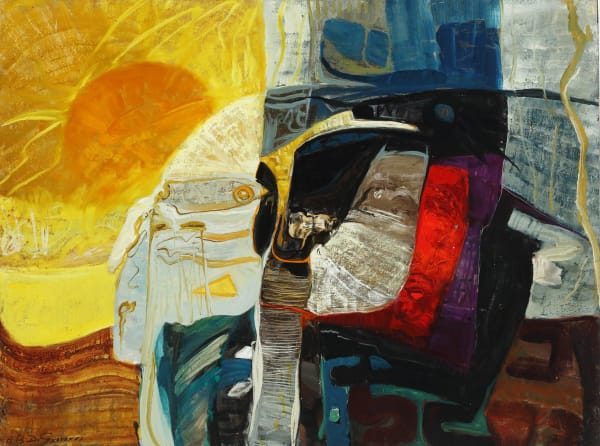
Dusty Griffith’s
newest works lead us irresistibly to fantasies and reveries about
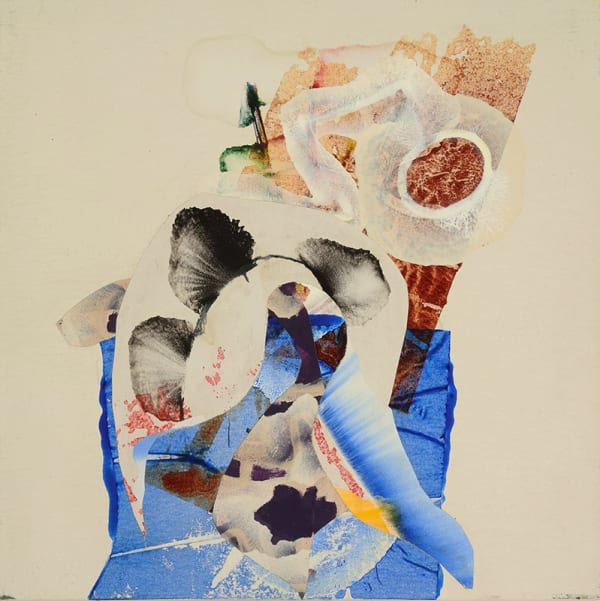
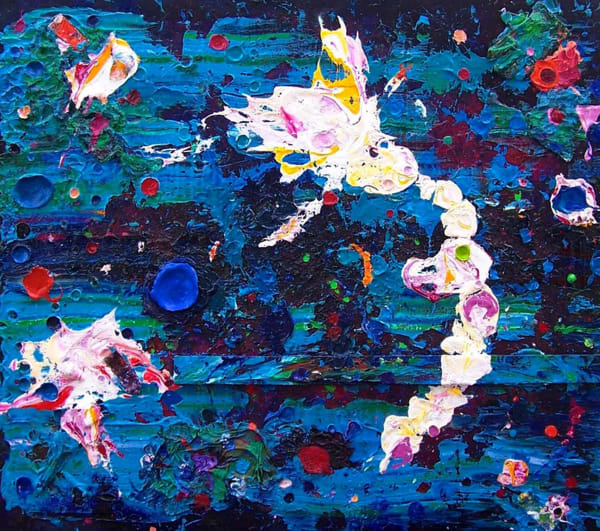
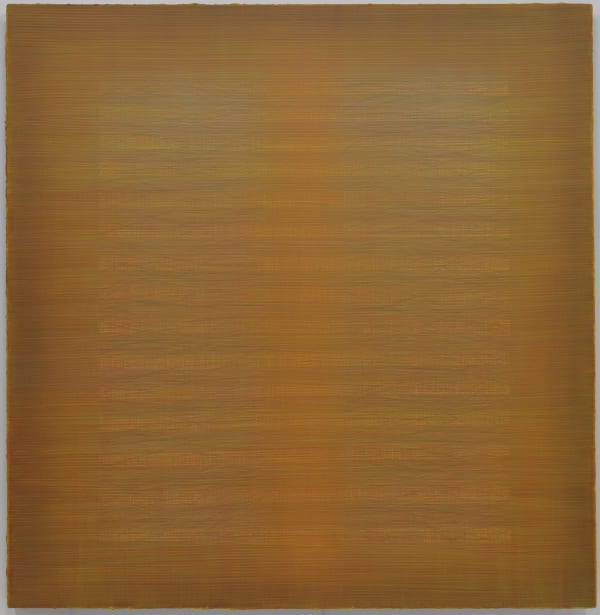
nature. The palette features the blues of shallow, crystalline
water, a range of yellows and tans that could reasonably be called
“earth colors,” and the pale greens of early spring, the colors seen
when the leaves have first unfolded from winter’s sheathing buds.
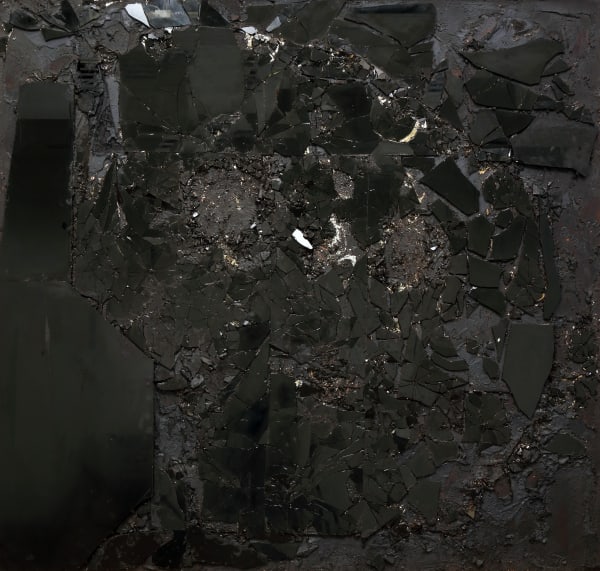
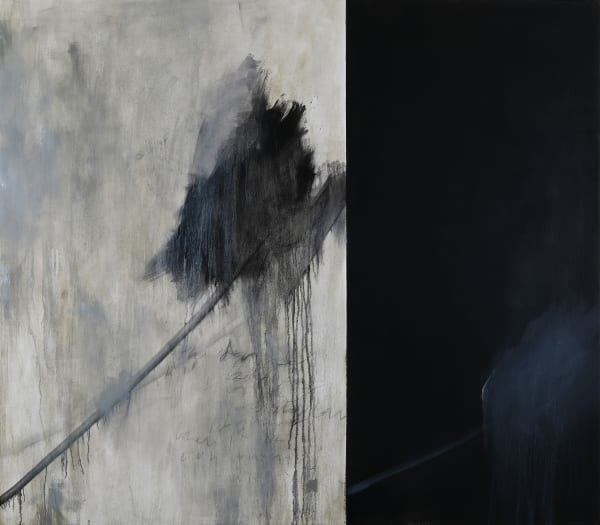
But the sense of depths buried within their built-up layers suggest
that René Daumal was right to incorporate the maxim in Mount
Analogue, “Beware of the surface of things.” These are not paintings
of pure sensory pleasure; they’re beginning road maps to potentially
infinite realizations. As the title of one of the new pieces has it,
“Look to Your Light in the Depth.”
“There is, in fact, something more than appearance.” That intuition
has fed philosophy and mysticism from the days of the pre-Socratics
in Greece onward. It was necessary for the thinkers of the
nineteenth century to insist on the counter-proposition, that
physical reality is all there is. The brief flourish of Hermetic
philosophy in the Renaissance paralleled the Buddhist assertion that
spirit and matter are not two, but that where there is a false
duality, neither of the terms reflects the actual condition.
More recently (though still a long time ago in the time span of our
accelerated culture), a mystically inclined Christian thinker wrote,
“There is another world, but it is in this one.”
And at the midpoint of the century just ended, American abstract
painters began to assert that the truths they believed were encoded
in ancient spiritualities and revealed analytically in-depth
psychology could be expressed on canvas. Mark Rothko and Barnett
Newman and Ad Reinhardt were atmospheric in opposite ways, skeptical
in a fashion appropriate to a cynical era, but each made claims for
the visual power of their artwork that went beyond simple aesthetic
appreciation.
Dusty Griffith reposes more comfortably in the language of faith.
The artwork in “Prayers” bears titles that derive from centuries of
Christian experience that retain immense potency in today’s America.
But his paintings, nevertheless, stand in a tradition that harks
back to midcentury modernism. (A small inset in one piece even
appears to quote Barnett Newman’s famous narrow vertical line, or
“zip.”) They also incorporate the visual language of such modernist
inheritors as Brice Marden.
We might return to the associations with nature suggested by
Griffith’s color ranges. If there is nature in the work that is
meant to lead beyond nature, is there also history that might lead
us beyond history?
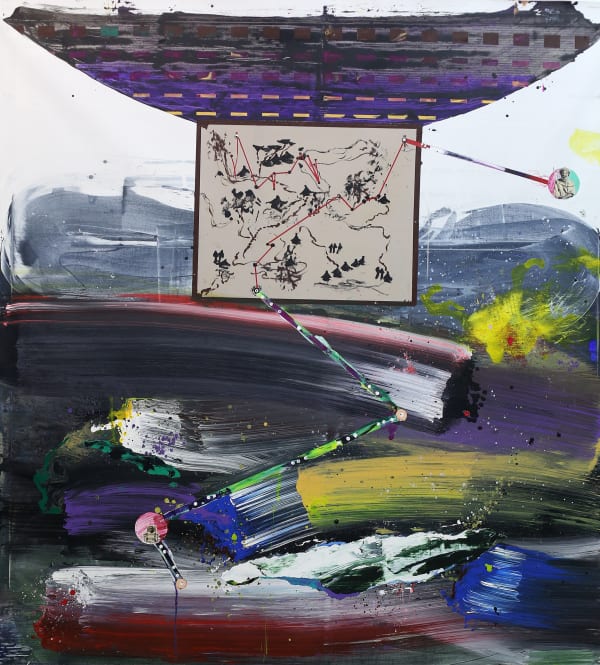
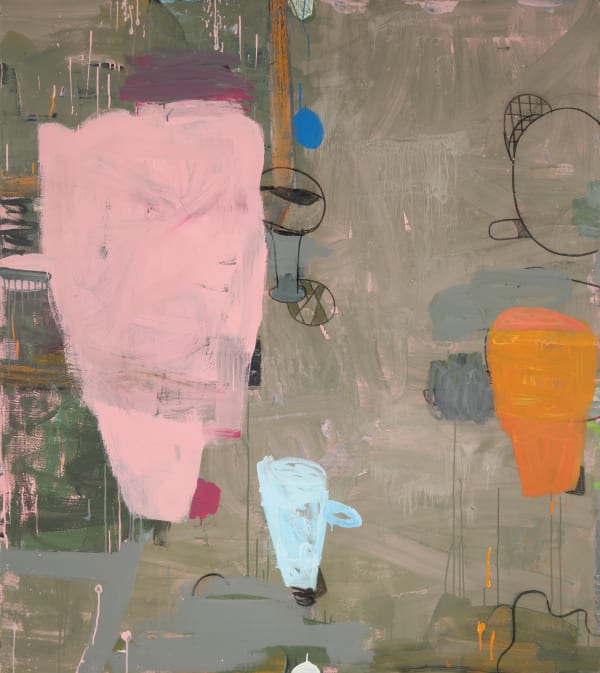
Well, yes. The Cy-Twombly-like markings in tiny portions of these
works suggest yet another late twentieth-century aesthetic parallel.
As with the other visual elements beyond the pleasures of color, the
embedded objects and reused scraps of wood have a private, personal
significance. But by the time they reach our eyes, they’ve become
aspects of a more than personal visual drama, and they present the
viewer with mystery rather than history.
Much artwork that incorporates objects into abstract compositions
does so in order to bring to bear the force of specific
recollection. In such works, historic images bring up old
nostalgias. We see bits of images we recognize, and we respond
emotionally.
There is no such nostalgia in Griffith’s paintings. There is,
rather, a sense that the world in all its variety conceals something
more meaningful, even if it is elusive to those who have no eyes to
see. Griffith teaches us to see, not more acutely, but more
contemplatively. We see that which we do not recognize, but we know
we have always known it.
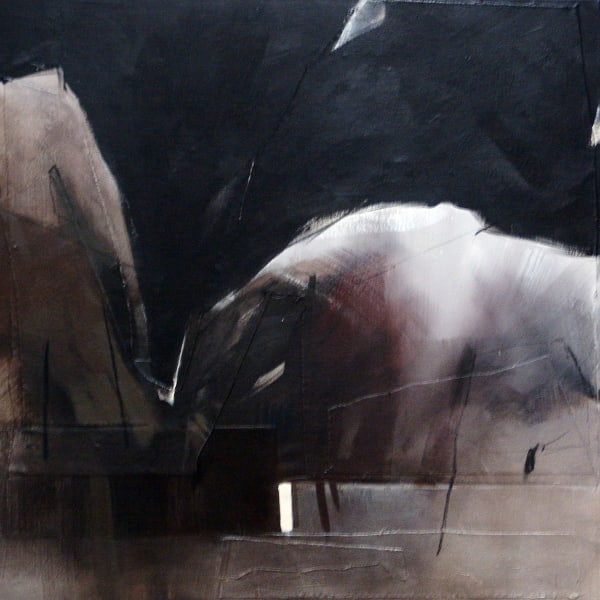
The gentle range of color encourages a meditative state in the
viewer. As with many of Mark Rothko’s canvases, it is possible to
fall imaginatively into the tonalities and remain there, lost in
thought and wonder, for a long time. Whether the spiritually
specific titles will lead the viewer in the direction Griffith might
wish: that all depends on the viewer. The casually inattentive will
notice nothing, because Griffith’s art requires an alteration in
viewing habits. However, the intrinsic structure of the work is
meant to seize the viewer’s attention and make transformation
possible. The visual pleasure it offers is a bait to lead the viewer
into a process of sensory and spiritual education that the early
Church Fathers knew well and wrote about in manuals for meditational
practice.
Griffith’s vision is fully and finally Christian, but it involves
what one spiritual authority calls “the accumulation of the force of
inner attention.” If he prays “Make Us Whole,” as one painting’s
title has it, he also offers the traditional symbols of the methods
by which an intermediate Christianity provided methods for reaching
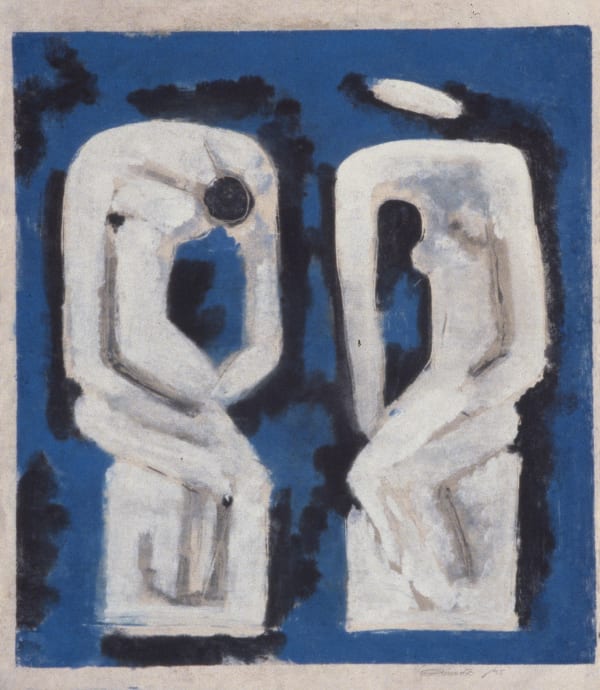
wholeness. We are broken; but the broken circles of his paintings
contain the vision of completion. What is to be achieved does not
yet exist, or is perhaps merely invisible. And it is the role of the
Invisible World to accomplish and finish that work of wholeness.
Griffith is pretty much committed to traditional symbols; the red of
blood, the blues of water that cleans or baptizes into the new life,
the golds or yellows of heaven. (So it is particularly ironic, or
else singularly appropriate, that they should suggest “earth
colors.” The Fathers who withdrew into the desert set out to make
the desert into a spriitual paradise: “On Earth As It Is In
Heaven.”)
And, of course, Griffith also cites the completed circles long used
to symbolize the mystery of the trinity: Father, Son and Holy Spirit
a unity in diversity, not just forces but Persons in which an
invisible and unknowable energy is known paradoxically. But the
paintings don’t tell us that. The theology of the church councils is
not the aesthetics at work in Griffith’s vision.
The paintings do tell us that there is something more that eludes
our ordinary condition, in which we are as oblivious as
sleepwalkers. If “There Are Signs That You Are Near,” as the title
of two new paintings put it, we don’t notice them. The Gospels tell
us we should be able to interpret the signs of the spiritual moment
as adroitly as we read the signs of coming weather fronts. Not to do
so is to fail to fulfill our ultimate destiny.
Griffith’s signs are dazzling; the incomplete circle isn’t just a
circle, it’s a Zen-like stroke that indicates in its sheer energy
how wholeness might become conceivable. This is not the total
depravity of certain theological positions; the physical beauty of
Griffith’s symbolism suggests that a good if fallen world still
holds within it the fragments of light of lost divinity. Humankind
can be restored because there is still a soul there to restore. The
task of redemption is also a task of awakening. The ingrained
loveliness that the nineteenth century Catholic poet Gerard Manley
Hopkins saw indwelling in matter (the “dearest freshness deep down
things” in the poem “God’s Grandeur”) is reflected in the look of
Griffith’s paintings. For him as for Hopkins, nature reflects
divinity, and the world is overshadowed by spirit.
Griffith uses luminescent materials to symbolize the inner light.
His vision is grounded in the Gospel’s “Let your light shine before
men,” but it’s further grounded in the realization expanded on by
the earliest writers of Christian theology, that the light must be
discovered before it can illuminate the path.
Hence the process symbolized by the water of baptism that washes
away the obstacles of inborn human limits. Baptism, the early
Fathers taught, begins a process of lifelong purification in which
the indwelling of the Spirit would lead to progressive divinization
through a return to a lost unity: “God entered into full union with
humankind so that humankind might enter into total union with God,”
in the Eastern Church’s formulation. But all of Christianity asserts
the possibility of return through an indwelling of spiritual
energies. This allows Griffith to pray, in the titles of these new
artworks: “Breathe Your Life Into My Soul,” “Flood Us With More of
You,” “Your Kingdom Come,” “On Earth As It Is In Heaven.”
We wouldn’t necessarily think this, simply looking at the paintings.
Geometric forms in modernist painting often represented hard, tough
rationality; soft surfaces and pastel colors represented an opposing
force, an enveloping celebration of the sensual and the sensory in
general. Griffith manages to combine both tendencies while turning
both of them upside down and rescuing them for spiritual purposes.
What in others is pure formalism has in his work a deeply intended
mission.
If we are to “Seek Your Living Water,” as the title of another
painting has it, we must first realize that there is a living water
to be sought, and a “you” to whom we might appeal for it. It isn’t
Griffith’s task to instill faith, much less to instruct in the
process of awareness that follows in the long journey out of the
self. He wants, rather, to instill in us the intuitions that might
lead to the perception that such a journey might be possible.
And as an artist, he does so with consummate skill. The minimal
scraps of red found in more than one of the paintings (but
spectacularly in “There Are Signs That You Are Near II”) suggest the
blood of redemption, but it’s also brilliantly placed flecks of
bright color in the midst of a subdued composition. The rhythms and
proportions of his assembled rectangles operate by rules that date
back to the Greeks and were refined by modernism to psychologically
charged perfection.
The history of religions would lead us to expect no other. Sacred
art has always operated by the same principles as secular (or
“profane”) painting. Indeed, Christianity asserts that God took on a
human body precisely because the spiritual must have a material
channel.
One need not accept any such theological thesis in order to argue
that Griffith’s work is religiously informed painting that can also
be read in purely formal, art historical ways. In fact, it’s more
instructive to begin with the demonstrable proposition that the
paintings change our way of seeing, that they have a job of
transformation to do and they do it well.
What we make of that perceived transformation is ultimately up to
us. But Griffith’s ability to find visible material analogues for
invisible spiritual processes has offered a point of entry into
realms of religious experience that elude ordinary verbal
definition.
That last observation is worth a moment’s reflection. Christianity
is thought of as a religion of the word, but the Word in the opening
verses of John’s Gospel is not an utterance but a light that shines
in darkness, and a light that enlightens humankind. Griffith,
likewise, is not uttering logical propositions, but propounding the
existence of a profound light, and of a water that slakes a thirst
of which we are mostly unconscious. Griffith’s paintings imply that
if we do not long for the indwelling breath that descends in the
Book of Acts like the rushing of a mighty wind, it’s because we
aren’t awake enough to realize we’re dying for lack of enough air.
So Griffith is out to wake us up, but to wake us up pleasurably. We
are to be, as in the book title of a currently popular thinker,
surprised by joy. But then we are to perceive the depths into which
we can dive, if we so choose, and the world unknown which we may
then begin to know and love.
However, we have freedom of action, at least insofar as any
sleepwalker has freedom of action. Even awakened to the
possibilities, we can choose to luxuriate in the details of
Griffith’s artistry, and live and lie on the surface of things. To
know that there are depths does not mean that the pleasures of the
surface cease to exist; it means that the vehicle exists to take us
further. Both art historically and spiritually, Griffith’s paintings
work. |