|
Markus Lüpertz: Paintings from Germany,
With a Wink and a Sneer
by Roberta Smith
Painting may go in and out of fashion, but its many lifesaving graces always keep it afloat. One is
its capacity for what might be called beautiful sarcasm, a sly self-parody while still looking good that
is cultivated by many young painters today.
For precedents, such artists might look to two exhibitions on the Upper East Side that feature little-known paintings made more than 20 years apart by well-known German artists: Markus Lüpertz at Michael Werner, and Martin Kippenberger at 1018 Art.
Both shows suggest that the tradition of beautiful but facetious painting is unusually strong in Germany. Perhaps it can be traced back to the acerbity of German Expressionism and especially the paintings of the Weimar period, if last fall’s exhibition of Weimar portraiture at the Metropolitan Museum of Art is any indication. It is also linked to the so-called triumph of postwar American painting, which was closely watched by students in Germany’s art academies in the late 1950s and ’60s.
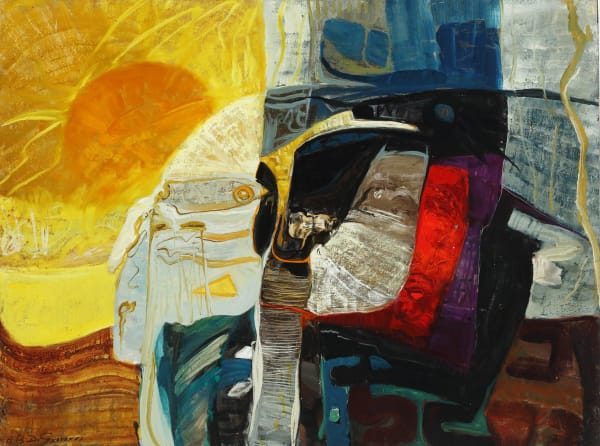
The American influence is palpable in the nine semi-abstract, richly colored canvases in Mr. Lüpertz’s show at Werner, which he painted in 1965, when he was 24. Based on photographs of camping tents from a department store catalog, they are second-generation Pop looking backward, trying to build an image out of formalist abstraction. They convert the saturated color fields of Barnett Newman and Mark Rothko into dry goods folded this way and that, tied to tent stakes here, given window flaps there. But their bite is buffered by romanticism: signs of the intuitive paint handling and symbolic motifs of an artist like Max Beckmann, not to mention a festive heraldry that reaches back to Sir Walter Scott.
They suggest the painter as a kind of poet-knight temporarily but happily exiled, and lack the pomposity of Mr. Lüpertz’s later images of army helmets and tweed-clad dandies. They may be the best paintings he has shown in New York.
Mr. Kippenberger was the premier bad boy of the raucous generation of German artists born mostly in the 1950s, after Mr. Lüpertz’s. His paintings at 1081 Art are more forthrightly caustic yet also more intriguing. They come from the artist’s two "Preis Bilder"series, whose title exploits the double German meaning of "preis": "price paintings" or "prize paintings." Two of those on view here were painted in 1987, when Mr. Kippenberger was 24, and the art market seemed out of control (how little we knew); the remainder date from 1994, a few years before his death, accelerated by hard living, from liver cancer at 43.
In each work variations on "preis" appear in fat dark letters across cheerfully all-purpose abstract fields. The wordplay implies a certain indifference to the market and art-critic approval. "Preislos," for example, means both "priceless" and "prizeless."
By suggesting that painting is a commodity-driven competition, the Kippenbergers skewer the success of Mr. Lüpertz’s more romantic Neo-Expressionist age group, conjure their own notions of fabric and mash together a laundry list of American painting styles, from Abstract Expressionism through Pop to Lyrical Abstraction.
The contrast of hard-edged bands and brushy slurps — the primary techniques of formalist painting — frequently recast the Modernist grid as cheerful, painterly plaids or checks redolent of drapes or tablecloths. Reds and hot pinks inveigle for the pleasure principle, although one canvas, "Tröstpreis," sticks to threesomes of grays. Its title translates as "consolation prize" or "consolation price."
Plastering a word or two across the face of an otherwise abstract painting has precedents in the work of Jasper Johns, Jim Dine and Ed Ruscha. But the real ghost in the machine may be the German painter Gerhard Richter, whose star rose to vertiginous heights in the years between Mr. Kippenberger’s two stints as a price-prize painter.
Interestingly enough, some in the 1994 batch are almost impossible to decipher technically, a well-known attribute of Mr. Richter’s abstractions. The colors are layered, but in what order — is tape used, or maybe even silk screen? Mulling over such mundane questions undermines the painting’s initial slapdash impression. Care balances sarcasm, and, oddly, beauty becomes more than skin deep.
The New York Times May 22, 2007
The
Sculptures Of Markus Lüpertz
by Donald Kuspit
What are we to
make of Lüpertz's rendering of the biblical Judith, a figure with a
manneristically elongated neck and abruptly foreshortened arms and
torso--a figure seriously at odds with itself, ill-proportioned
almost to the extent of being a freak of nature? At the same time,
it stands--on normally proportioned if somewhat husky legs -- in the
classic contrapposto position, emblematic of ideal human balance.
Where is the sword of this mighty, clever woman, who is usually
shown cutting off the head of the male tyrant with whom she has
slept, to save her people? Or of Lüpertz's St. Sebastian, a
one-armed figure painted in red -- the blood dripping from his
wounds?--who stands defenselessly before us, his thin, vulnerable
body mounted on long, sturdy legs? Where are the arrows-the symbol
of his suffering--that are his usual attribute?
These two figures--images of a female heroine and a male victim,
both martyrs, in their different ways, for a sacred cause--are
radically exposed, radically naked, their bodies a tragic, distorted
raw material, urgently--primordially--expressive. They are
astonishingly unique representations of classic themes. Wieland
Schmied, who has described Lüpertz as "vital and volatile artist"
who "abandons" a "theme" after transforming it,(1) misses the point,
which is the radical character of the transformation. Lüpertz gets
to the root of what he transforms, again and again: the body, in all
its physical and emotional fundamentality. This is why his Judith
and St. Sebastian are stripped of the attributes-sword and
arrows--that give them their social identity. Lüpertz is interested
in something more fundamental--and modernist--than social causes,
however just: the archaic body, in all its expressive resonance and
originality--the body as the basic expression of human being, and
the basic source of all too human feelings. I will argue that
Lüpertz's sculpture is an astonishing re-invention of figurative
sculpture, even more crucially, the consummate statement of the
modernist vision of the figure: the figure as body ego--the first
ego, as Freud said, that is, the most primitive and organic and
physical ego. This raw figure challenges and undoes the idealistic
vision of the figure as sublime or transcendental form, which has
dominated Western art since antiquity. But the modernists regarded
it as inauthentic--a false vision, however preferred; only the raw
body, expressive without any cultural mediation, was authentic and
truthful.
There is no question that there is also a manneristic intelligence
at work in Lüpertz's sculpture. Necessarily so, for the modernist
figure seems abnormal in comparison to the traditional figure. And
necessarily so because postmodernism permits the combination of
supposedly incompatible styles to new expressive effect--styles that
modernism deliberately kept apart, as though if one contaminated the
other all would be artistically lost, as T. W. Adorno argued.(2)
"The mannerist wants to say things not normally but abnormally,"
Ernst Robert Curtius writes. "He prefers the artificial and affected
to the natural. He wants to surprise, to astonish, to dazzle. While
there is only one way of saying things naturally, there are a
thousand forms of unnaturalness."(3) But the modernist primitive
figure, in all its variety--from Picasso to Matisse in France, from
Barlach and Kirchner in Germany, whose figurative sculptures are
among Lüpertz's sources (not models)--seems inherently unnatural
from the point of view of the naturally proportioned, anatomically
correct, normally modeled traditional classic figure. No doubt
Lüpertz carries the modernist figure to an extreme, making it seem
altogether abnormal--absurd. But he does so in order to make a point
that is in danger of being lost in postmodernism: that the triumph
of modernism was its primitivism--"primordialism," as I prefer to
call it--which had more to do with bodily expression than with
abstract esthetics. Esthetic innovation was the means to the end of
primitive expression, and primitive expression is characteristic of
the body ego, which early modernism--modernism before it became
fetishized in pure abstraction--discovered, explored, and
celebrated. Lüpertz returns to the expressive originality of the
primitive body, that is, the primordial domain of bodily expression,
and extends it in cunning ways--especially by combining it with
aspects of the classical figure, an act of manneristic bravado
bordering on bravura--in order to generate new, unexpected
primordial expressions, as though to show that the body is an
unfathomable, inexhaustible cornucopia of them--a perpetually
strange terra incognita of expressive surprises.
Lüpertz, then, uses manneristic combinatorics, characteristic of
postmodernism --which has been called a neo-mannerist period--to
preserve and extend the modernist revelation of the primordial body,
and above all to make its expressive uncanniness as explicit as
possible. This is ironical: he sustains unadulterated bodiliness and
uncompromising expressivity by time-honored and socially adulterated
stylistic means. In fact, his greatest mannerist triumph is to bring
together, in the same figure, Mediterranean idealism and German
realism, that is, to make the human body seem as "essential" as it
does in Mediterranean art and simultaneously as "existential" as it
does in German art. Since the Northern Renaissance, the standing
ambition of German art has been to reconcile the Mediterranean sense
of the body and the German sense of the body, which are inherently
at crosspurposes. Albrecht Dürer was the first German artist who
deliberately set out to do so, and more or less succeeded. He
apparently reconciled the irreconcilable, artistically inventing a
"model" body that seemed superior to the Mediterranean and German
models because it combined the most salient chararacteristics of
both. But Lüpertz is less interested in synthesizing antitheses than
in playing them off one another, that is, manipulating their
irreconcilability to new and unusual expressive effect. He heightens
the friction and tension between them rather than overcomes their
differences. It is this that gives his figurative sculptures their
expressive singularity and uncanniness--their dazzling irreality and
primordiality. The irony of Lüpertz's figures is that, for all the
intellectualism of their combinatorics--and many of them seem like
juggling acts, in which radically different parts are kept in play
in the same space, resulting in a monstrous but convincing
figure--they seem like fresh expressions, full of bodily life. In
other words, each seems to express the True Self,(4) however
burdened by historical self-consciousness--a sense of déja vu.
In Mediterranean art the body tends to be a harmonious whole that
transcends its physical parts, thus becoming peculiarly
"metaphysical," while in German art it tends to be distorted,
sometimes to the point of grotesqueness--"Gothicness"--by reason of
the discrepancy or incongruity between its parts, emblematic of the
contradictory feelings that have free play in the body ego. Thus
Lüpertz's Judith and St. Sebastian have a Mediterranean lower
half--their legs are appropriated from classical sculpture, in the
case of St. Sebastian archaic classical sculpture-while they have a
Germanic upper half, that is, their upper bodies are an almost
bizarre agglomeration of incommensurate parts. The Actor, The
Gardner, and Odalisque are conspicuously bizarre groupings of
objects and surfaces, precariously held together in an "abstract
expressionist" construction. Regularity and
irregularity--rationality and irrationality, the stable and the
unstable, the expressionistic and the constructed--tensely converge
but do not clearly unite. The result is a sense of uncanny
wholeness--wholeness in the process of being torn apart, that is, "dionysiac"
or "dithyrambic" wholeness, to use Lüpertz's terms.(5) They have the
surreal convulsive beauty that André Breton thought was
characteristic of modern life. It is a wholeness or beauty that is
lyric and morbid--vital and decadent--at once. Similarly, Lüpertz's
engagement with the primitivism of the modernist past is decadent,
even as his manneristic apotheosis of it restores it to expressive
credibility. Indeed, Lüpertz separates its emotional truth from its
style the way a kernel is separated from chaff.
Lüpertz's traditionalism--his dependence on the museum-is
particularly evident in Titan, the quotation of an archaic classical
statue, whose heroic body has been ruined by modernist
fragmentation. At the same time, the figure looks like an
archaeological discovery whose fragments have been pieced together,
making it once again whole, however incompletely. Paradoxically, it
is the figure's incompleteness and fragmentation that make it
freshly--primordially--expressive. It is as though the basic
expressivity of the figure is revealed for the first time: as
though, because it has been broken into a sum of fragments that add
up to an inconclusive whole, and because it no longer belongs to its
times--because time has liberated it from its historical and
cultural meaning--it can be experienced in all its expressive glory.
No longer of any existing time and place, it takes its place in
Malraux's museum of the imagination, where it at last resonates with
emotional meaning and depth. Many of Lüpertz's sculptures have in
fact an air of archaeological--not to say antiquarian--splendor, as
though he wanted to demonstrate that artistic forms from the dead
past still had authentic life in them. In becoming abstract ruins,
they had in fact become more elemental and expressively true to
themselves.
Lüpertz's modernism is evident in Shepherd, which owes a good deal
to Picasso's Man with a Lamb, 1943, a dependence indicated by the
fact that Lüpertz's figure also tenderly carries a lamb, if on his
shoulders rather than in his arms. But the head of Lüpertz's figure
is painted with expressionistic vigor, and the figure as a whole is
more conspicuously archaic than Picasso's, as its torso and legs
indicate. Lüpertz's Head of a Woman (Head of My Mother) owes a
certain debt to Lehmbruch, as its elongated neck--a familiar
mannerist abnormality and absurdity, in direct contradiction of
classical proportions, intended to make the figure uncanny and
provocative, and thus all the more expressive--suggests, even as its
surface is articulated with expressionistic extravagance. Elongated
necks, painted surfaces, and vehemently gestural texture also appear
in Woman with a Jar and Black King, creating an effect at once
manneristic, expressionistic, and archaically classical--an original
synthesis of competing modes that expressively re-originates them,
as it were. All are of course now available for the postmodernist
asking.
Standing Nude, with its crude, primitive look, owes a debt to
Matisse's modelled as well as Kirchner's carved figurative
sculptures. But it is hardly the customary postmodern reprise, as
its dramatic use of paint and the startling discrepancy between its
smooth mask-like face and bulging, roughhewn body indicates. Strange
as it may seem to say so, Lüpertz's bizarre Goat Head owes as much
to Barlach, by reason of its dramatic positioning, as it does to
Picasso's various animal head sculptures, particularly the head on
his 1950 Goat sculpture. The Medici and The Moor also have a
Picassoid cast, even as they are painted and texturalized in an
expressionistic way. Indeed, they are reminiscent of Cobra
sculptures, if more mocking of humanity.
There is a comic streak in Lüpertz, side by side with his tragic
sense of art: his is stuck on the horns of a dilemma, not knowing if
it is authentically primitive expression or an eccentric
recapitulation of art history designed to generate yet another
signature style. Like other 20th century artists, avant-garde and
neo-avant-garde, he wants to strip the stylistic veneer from
primitive expression. He wants to give it free rein--take expressive
license, to the extent of allowing expression to become inchoate,
even chaotic. At the same time he acknowledges, by way of his
ransacking of art history, that only style gives us a handle on what
is otherwise too hot to handle--the raw body that is the most
primitive of expressions, and as such emblematic of the expressive
rawness of life as such. Without the attempt at stylistic control,
we are at the mercy of uncontrollable instincts, and in fact a good
part of the importance of Lüpertz's figures is that their bodies are
on the verge of disintegrating into raw instinctive expression, even
as they maintain idiosyncratic integrity--desperately hold together,
whatever the grotesque result.
Perhaps the single most stunning integration of modernist
Mediterranean style and a traditional German theme is Lüpertz's
series of five Dance of Death sculptures. They present opposing
states of being-War and Peace, Youth and Age--that climax in the
literally dead nature (Nature Morte) of a skeleton, coming out of a
huge vase like an ironical genii. The primitive figure of War sits
astride a similar vase--a deceptive womb or Pandora's box?--and the
figure of Peace embraces it. The figure of Youth holds it between
his legs, suggestively mounting it as though it was a woman, while
the figure of Age leans against it for support, bending it in with
the weight of his bent body. Confirming his archaic tendencies,
thematically as well as formally, Lüpertz is clearly using a
traditional convention--allegorical figure and symbolic vase, but
also organic human form and quasi-organic geometrical form--that can
be traced back to antiquity.
At the same time, stylistically, the Dance of Death series derives
from Matisse's series of four Backs (ca. 1909-30), which show a
figure becoming more and more primitive and abstract, and
ambiguously sinking into and emerging from--differentiated from and
merging with--a ground as materially raw as it. Thus, Lüpertz's
series is an original representation of a traditional German
theme--indeed, one the Germans have been obsessed with since its
rendering by Hans Baldung-Grien and Hans Holbein--and makes original
use of what by now is a traditional modernist style. Lüpertz always
reinvigorates what he revives, undermining the tendency to reify and
academicize that is inescapable in art history. He accomplishes this
in large part by manneristically suggesting their convergence, as
noted-in this case by using primordial expressionistic style to
re-articulate, as it were, an existential truth. In Lüpertz's
handling, eschatology and expressionism show that they are made for
each other. His expressionistic handling of an eschatological theme
results in a new epiphany of the primordial vitality and suffering
of the body. The body is full of life, but it must die, and is at
its most expressive in death. In fact, expressionistic style has
been understood to have apocalyptic import--it is the terminal as
well as seminal style of life; Lüpertz makes this explicit. As
always, he is occupied with what is most inescapable in human
existence.
The stunning Dance of Death tour de force seems to be mocked by
Lüpertz's somewhat smaller three Drinking Ghosts--black drinking
cups (one a bottle), each with a little demonic head (one a
death's-head)--but the effect is equally profound and complex. For
the cups are found objects--they owe a certain debt to Picasso's
1914 Absinthe Glass--and the heads are reminiscent of those found on
Romanesque and Gothic cathedrals, indicating once again a fusion of
modernist ideas about art and traditional themes. The devil--the imp
of the perverse, to use Edgar Allan Poe's words--can appear
anywhere, as he did in medieval times. No doubt Lüpertz skirts
kitsch, with what may seem coy deliberateness--one cannot help
thinking of the Disneyesque creatures proliferating in horror
films-but kitsch, too, engages fate, if with no understanding of it,
and little real fear and trembling, which are the emotional
substance of Lüpertz's sculptures.
Lüpertz first came to prominence as a sculptor with his Alice in
Wonderland series (ongoing throughout the 1980s), and some of the
figures in his current exhibition seem related to those in the
series, particularly the heads of The Medici and The Moor. They seem
to belong to the same insane underworld, which Lüpertz understood to
be the implicit theme of Lewis Carroll's masterpiece. Their
convulsive, diabolical character suggests as much. But they also
have a human grandeur that the Alice in Wonderland sculptures lack.
Lüpertz's new figurative sculptures show a melancholy yearning for
the heroic--for the courage that once was, whether in the moral form
of Judith or St. Sebastian, or the warrior form of the Titan. Their
colorfulness--in the midst of their black humor--is a deliberate,
defiant show of joie de vivre, reminiscent of the proverbial
Dionysian revelry one sees depicted on so many ancient tombs, as
though to deny the loss they mourn and memorialize. Humor, however
black, and joyous color, however ironical, still remain the best
defenses against the underlying grimness of life. In the last
analysis, Lüpertz's figurative sculpture--clearly allegorical--has
more to do with bringing dead ideals to expressive life than with
mannerist irony.
Notes
(1)Wieland Schmied, "Points of Departure and
Transformations in German Art 1905-1985," German Art in
the 20th Century: Painting and Sculpture 1905-1985
(London: Royal Academy of Arts and Munich: Prestel,
1985), p. 66
(2)T. W. Adorno, Aesthetic Theory (London: Routledge &
Kegan Paul, 1984), p. 65 asserts that "expression and
construction" are the extremes of modernism, and that
each is at its best when it remains uncontaminated by
the other, that is, pursued for its own pure sake. This
is a standard modernist idea; it has lost its
credibility and rationale in postmodernism. Now the
extremes make sense only when they resonate with each.
Without their crossfertilization, each reifies into a
cliché. Purity has become vacuous; only hybridism, which
is what we see in Lüpertz, is vital, however ironical
the self-contradictory result.
(3)Ernst Robert Curtius, European Literature and the
Latin Middle Ages (New York: Harper & Row, 1963), p.
282. Curtius regards Mannerism as "opposed to
Classicism" (p. 273) while feeding off it, which
certainly describes Lüpertz's relationship to classical
Modernism. (Ironically, it stands in manneristic
relationship to Classical representation.) In general,
Mannerism "emphasize[s] the tension between conflicting
stylistic elements...express[ing] the conflict of life
itself and the ambivalence of all human attitudes...the
permanent ambiguity of all things," which "finds its
purest and most striking expression in paradox." (Arnold
Hauser, Mannerism [London: Routledge & Kegan Paul,
1965], p. 12.) Lüpertz's figurative sculptures clearly
reveal mannerist "paradoxical form." It should be noted
that Werner Haftmann, Painting in the Twentieth Century
(New York: Frederick A. Praeger, 1966), p. 64 argues
that "the Nordic [German] artist" has a tendency to
"exalt the situation of conflict to the point of
morbidity," which in fact is characteristic of Lüpertz's
mannerism.
(4)D. W. Winnicott, "Ego Distortion in Terms of True and
False Self," The Maturational Processes and the
Facilitating Environment (New York: International
Universities Press, 1965), p. 148 describes the True
Self as "com[ing] from the aliveness of the body tissues
and the working of the body functions." It manifests
itself in "the spontaneous gesture and the personal
idea." Each of Lüpertz's figurative sculptures is in
effect a personal idea made manifest in spontaneous
bodily gestures.
(5)Schmied, p. 66. "Dionysus dithyrambos" literally
means "Dionysus, who stands before the double door." For
the Dionysian cult this referred to the initiate who had
experienced the fearful mystery of second birth. Violent
sacrifice seems to have been involved in the ritual of
rebirth, as Euripedes's Bacchae suggests. Thus, in
describing his art as dionysiac and dithyrambic, Lüpertz
in effect declares that he is doing violence to what it
deals with--sacrificing his epic figures to restore them
to the primordial authenticity of lyric expression.
|